

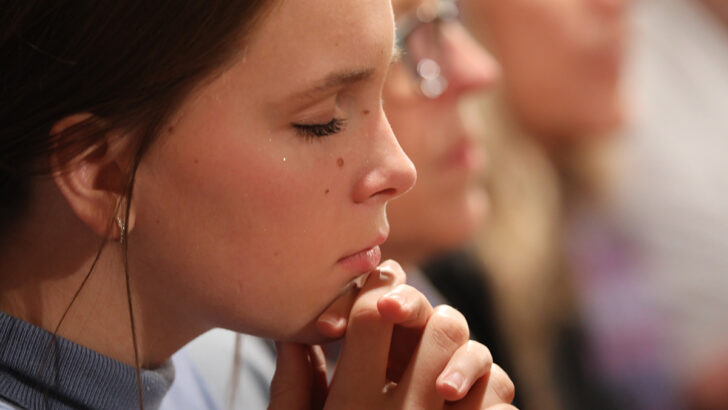
 A young woman prays in this archive photo at the National Prayer Vigil for Life in
Washington, January 19, 2023. Photo: OSV News / Bob Roller
A young woman prays in this archive photo at the National Prayer Vigil for Life in
Washington, January 19, 2023. Photo: OSV News / Bob Roller I recently completed a piece of research involving students across ten post-primary schools in Ireland, which demonstrated that there are inextricable links between religion and the psychological wellbeing of young people in this country. This research emerged through my work in schools as a psychologist, where conversations with young people about the factors influencing their mental health repeatedly highlighted religion as a significant area. Given the lack of research on this topic in the Irish context, it became a natural and compelling focus when the time came for me to select a doctoral research topic.

The first phase of the research involved online questionnaires completed by over one hundred students in Transition Year, Fifth Year and Leaving Certificate classes. These questionnaires measured three areas: religiosity, religious coping, and psychological wellbeing.
Religiosity
‘Religiosity’ refers to how religious a student is, based on their beliefs, practices, and sense of belonging to a particular faith tradition. ‘Religious coping’ describes how young people use their religion to deal with life’s challenges. This can take both positive and negative forms. Positive religious coping includes practices such as personal prayer, meditation, seeking comfort through scripture, practising gratitude and forgiveness, and placing trust in God during difficult times. Negative religious coping, by contrast, can involve anger towards God, feelings of abandonment by the Church, or interpreting life events as divine punishment.
Finally, ‘psychological wellbeing’ refers to a state of mental and emotional health, including factors such as resilience, purpose in life, and the ability to cope with stress.
The findings revealed a complex but meaningful relationship between religion and mental wellbeing. Students who believed in God and held strong religious beliefs were more likely to report higher levels of wellbeing. Similarly, those who engaged in positive religious coping tended to report a stronger sense of purpose in life. One student captured this connection powerfully, stating: “I think you can’t have a good mental wellbeing, a good mental health, without being grounded in your own faith and knowing what you believe in, and why you believe in it.”
If something bad happens, I feel like it’s happening for a reason… that God is there and that He has a plan, and that something even worse could be happening”
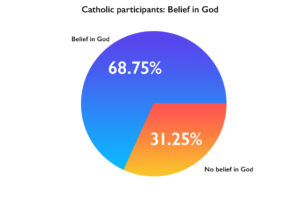
In contrast, students who relied more on negative religious coping methods were more likely to experience lower levels of wellbeing. Interestingly, while 80 participants identified as Catholic, only 55 reported belief in God, raising important questions about what religious identity means for young people in Ireland today.
The second phase of the research involved in-depth interviews with seven students. These conversations provided a richer understanding of how religion is experienced by them in everyday life. Across the interviews, students described a range of ways in which their faith supported their mental wellbeing.
Prayer emerged as one of the most significant supports. Many students described it as a calming and grounding practice during times of stress and anxiety. As one young person explained: “I can just say the Rosary and, like, it kind of calms me down in a sense, that I’m not as worried.” Another added: “It kind of helps me stay grounded and not get really flustered or overwhelmed… I think praying is the main thing… if I’m having a very stressful day, I can just sit down and relax and pray.”
Comfort
Students also spoke about the comfort they derive from believing in God’s presence and purpose. This belief helped them to reframe difficult experiences and cope more effectively with uncertainty. One participant reflected: “If something bad happens, I feel like it’s happening for a reason… that God is there and that He has a plan, and that something even worse could be happening.”
Religious practices such as Confession were also highlighted as beneficial in terms of processing guilt and personal struggles. One student noted: “(Religion) allows me to explain some of the things I’m going through through faith-based stuff… and Confession is also really helpful to get things off my chest and clear my conscience.”
Faith also played a vital role during times of grief and loss. One particularly moving account described how belief sustained a student following bereavement: “Without religion, I don’t think I would have been able to cope… when you lose someone… having God to come to, and believing that my granddad is gone somewhere better… I don’t think I would have been able to cope without religion. It definitely gets me through the tough times.”
Faith, for many of these students, is not simply a set of abstract beliefs, but a lived resource that shapes how they understand and respond to life’s challenges”
In addition to individual practices, the social dimension of religion was also significant. Participation in religious communities and youth groups helped students to build friendships and feel a sense of belonging. As one student shared: “I think it kind of helps me make friends as well… being social and active with people around the parish… meeting people who feel the same or differently and being able to talk about it.”
The findings of this study suggest that religion has the potential to positively impact young people’s mental wellbeing, particularly when beliefs are internalised and expressed through positive coping strategies. Faith, for many of these students, is not simply a set of abstract beliefs, but a lived resource that shapes how they understand and respond to life’s challenges.
For young people, this raises an important question: are the coping strategies you rely on more positive or negative in nature? Developing greater awareness of this can be a valuable step towards improving mental wellbeing.
For those of us who parent, teach, or work with young people, there is also a clear implication. Supporting young people to engage with their faith in meaningful ways can have significant psychological benefits.
Coping methods
This can be achieved by encouraging the use of positive religious coping methods; for example, guiding young people in developing simple, regular prayer practices; encouraging them to speak openly to God about what they are going through; introducing reflective practices such as lighting a candle or spending quiet time in a church; and helping them to engage with meaningful devotions such as the Rosary or the Sacrament of Confession as a way of finding peace and clarity. It can also involve supporting young people to draw on scripture for comfort, to practise religious gratitude and forgiveness, and to develop a sense of trust from a faith-based perspective that there is meaning and purpose even in difficult life experiences.
Equally important is addressing negative religious coping. This might involve gently challenging beliefs that frame God as punitive or distant, supporting young people to express religious doubts and questions openly, and helping them to reframe difficult experiences in a way that emphasises hope, compassion, and meaning, rather than fear or guilt.
Ultimately, the research highlights that religion, when experienced positively, can serve as a powerful support for young people’s mental wellbeing. It can provide a sense of purpose, a framework for understanding life’s challenges, a source of comfort in times of distress, and a community of belonging.
In an era where young people face increasing pressures and uncertainty, these findings offer a valuable reminder of the role that faith can play in fostering resilience and flourishing.
Dr Lydia Mannion is a Lecturer in Inclusive and Special Education at Mary Immaculate College, Limerick, where she works with student teachers at both undergraduate and postgraduate levels. Previously, she worked as both a primary school teacher and educational and child psychologist.
This research received funding from Mary Immaculate College, Limerick, and the Teaching Council of Ireland.