

 Mary Kenny
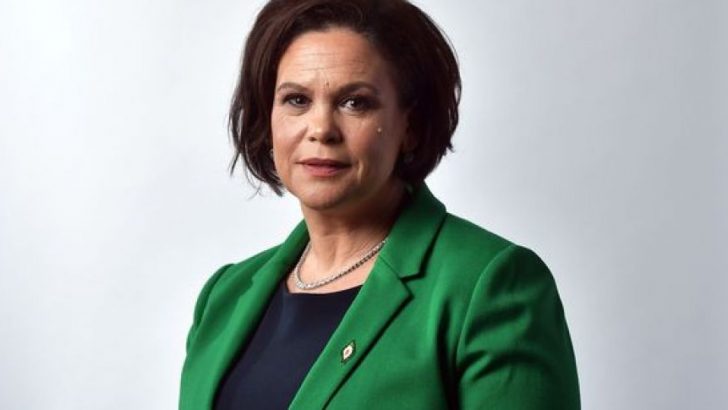 Mary Lou McDonald
Photo: Newstalk.com
Mary Lou McDonald
Photo: Newstalk.com Now we come to a subject which is both personal and public, individual and political; impolite to mention and yet relevant to perception and communication. And possibly linked, also, to vanity.
This concerns a person’s – most often a woman’s – face.
It is a matter of obvious commentary that the Leader of the Opposition, Mary Lou McDonald, has recently appeared looking remarkably well, subtly changed and evidently rejuvenated. The response I have heard, notably among women, is “good for her!”
If she has had ‘work’ done on her appearance, what’s wrong with that? Broadcasters like Anne Robinson boast of their professional relations with their cosmetic surgeons, and, from what one hears, hardly anyone in California hasn’t undergone such ‘work’.
Lines
Though I’ve never gone under the facial knife, I did have a session of Botox treatment some twenty-five years ago. The idea of injecting rat poison into one’s forehead might seem bizarre, but the purpose was to erase frown lines, which make one look cross, and freeze the frowning reflex.
But where do we draw the line between “vanity, vanity, all is vanity”, as St Thomas à Kempis warns, and a perfectly reasonable endeavour to present a pleasant face to the world?
Feminism – like Christianity – rejected the culture of the cosmetic. We shouldn’t judge a woman by her appearance; even Shakespeare’s Hamlet equated “painting” the face with capriciousness.
In a visual age, the optical focus has intensified, and grooming and presentation have grown glossier”
And yet the cosmetic firm L’Oréal claims that their products have enhanced female self-esteem with its slogan: “Because you’re worth it.”
Back in the day, Bernadette Devlin became an international political figure, though she seldom seemed to apply a dab of lipstick. Angela Merkel never sought to look prettified.
But in a visual age, the optical focus has intensified, and grooming and presentation have grown glossier. Notice that Sinn Féin’s Michelle O’Neill evidently pays attention to costume and make-up, and would win any ‘glamorous granny’ competition. This has increased her ‘visibility factor’ in the media.
Substance
So, if Mary Lou, 57, has taken measures to enhance her appearance, it can be seen as just part of her job. Someone constantly before the cameras is entitled to maximise their looks. Presenting a public ‘face’ is part of a strategy for anyone in this arena.
But appearance is not the same as substance. A person with a plain or wrinkled face is of just as much value as a striking beauty: handsome is as handsome does. L’Oréal may adorn but does not define character or virtue.
===
Anyone who supports a united Ireland – and the majority of us do, in theory – will be informed and entertained by Paul Howard’s best-selling satire A Nation Once Again.
The opening scenario is fantasy, but almost believable: since 1958, a secret Dublin government department, operating under the cover of the Office of Public Works, has been beavering away preparing for the reunification of this island.
And as the goal of reunification is now evidently coming towards us, Fiach O’Bric, a retired diplomat, is bounced into putting some fizz into this operation. He is called to manage a fantastical, and yet plausible, cast of characters as an advisory team, from the unreconstructed veteran Republican to the snowflake intern who has to Google ‘partition’ to grasp the fact.
Flags, policing, constitutional law, tourism, agriculture, health budgets, transport, education, infrastructure, signage – all must be researched, and prepped for amalgamation. Howard (also known as Ross O’Carroll Kelly) hardly exaggerates the challenges involved, represented by the competing characters.
It’s a scream – and I like the idea of building a new compromise capital, as the Australians did with Canberra, right in the geographical middle of the country.
Then comes a real-life event like the contested march down the Garvaghy Road, and we hardly need a satire to spell out the difficulties, and the cultural distance yet to be covered.
==

Vive le Pape!
We hear a great deal about the ‘slop’, not to mention the offensive rubbish, and toxic commentaries, that appear on social media. Yet during Pope Leo’s amazing visit to France recently, ‘X’ (formerly known by its nicer tag, Twitter) was invaluable, I found. Wonderful videos and reports were streamed to my screen, as Leo was cheered by huge crowds of French people, and said Mass at the Place de la Concorde, where King Louis XVI was guillotined in 1793.
The reportage was so detailed and lively – in contrast to the Irish mainstream print media, where the coverage seemed meagre and underplayed, even grudging. Indeed, the British press provided more lavish coverage, with stunning pictures of the Champs-Elysées thronged with celebratory crowds, a fabulous firework display and a tableau of France’s long connection with the faith, going back to Clovis and Joan of Arc.
What came across, most vividly in these video reports, was the sense of joy with which Leo was greeted, to which he responded with palpable warmth, but also personal modesty.