

 Peter Costello
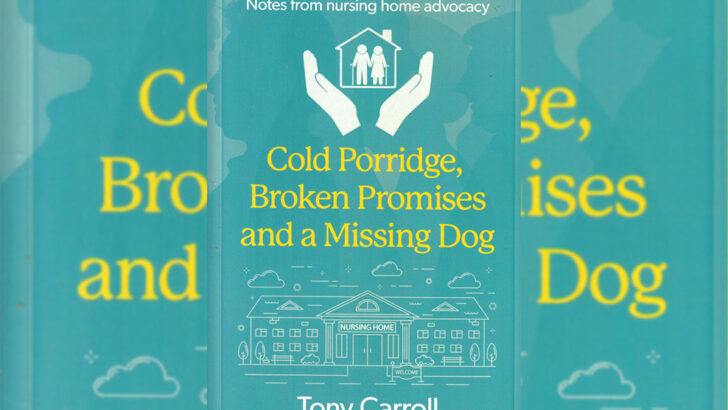 a first copy of his revealing book
 Cold Porridge, Broken Promises and a Missing Dog: Notes from Nursing Home Advocacy
Tony Carroll
Scribe Consulting Services, €20.00 / £18.99; widely available on line and through shops
It is something of a surprise that this deeply felt and engaging book had to be self-published, rather than appear from under one of the well known imprints. Publishers are said to know their own business, but there are times when important and revealing books about Irish society come to us in this roundabout way.
The author, Tony Carroll, a former HSE project manager, is a Dubliner with more than forty years experience of visitation and professional elder advocacy and mediation, in both public and private nursing homes.
Innocence
He adds that he was a member of the multiagency National Advocacy Programme Alliance (NAPA), which was set up following the revelations of abuse at the Leas Cross nursing home in Dublin. As well as continuing his pastoral work, he is also involved with Alone as a volunteer community visitor and telephone befriender.
Given the nature of his work and the various emotions involved with elder care, he has chosen to cast his material in the form which is basically a report from the front line of an ageing society, not as a piece of journalism as such, but as a fact based narrative in which names of people and places are changed (as in that famous old TV show of the 1950s): “Ladies and gentlemen: the story you are about to hear is true. Only the names have been changed to protect the innocent.”
But protecting the innocent is only part of the matter: it will be for others in public life to punish the guilty.
The family members he sees as having a tendency to take over, to say what they think the person would say if they were able to say it”
He calls it “a work of creative nonfiction”. All the events took place and are presented to the best of his memory, but are fictionalised or altered. This is understandable, as we Irish are a highly litigious nation as we and the courts well know.
It would be good as well to attend to the book’s epigraph, taken from a newspaper article of September 2022,”You should care about the state of our nursing homes – you may well end up in one”.
Near the beginning, however, he makes a remark which may well go to the heart of the matter. “One of the ongoing problems in advocacy for the older person is trying to keep family members at bay”.
The family members he sees as having a tendency to take over, to say what they think the person would say if they were able to say it.
But the advocate is there to help the residents speak for themselves, which is not always an easy matter and demands experience, patience and insight.
Fiction
This said, the book often has the vivid presence of a novel, which makes it very readable. In the course of the book Carroll touches on every aspect of the life he is involved with, which are as many and varied as the people he is engaged with. He is able to selectively dramatise certain situations so as to emphasise them in a way which would be impossible in an ordinary report.
But this being the case, readers should not assume that ‘fiction’ is devoid of ‘fact’. The text is fully annotated with references filling some 26 pages, and explanations of allusions, much as in an academic book. Again, as in an academic book, there is also a very full bibliography and a list of additional resources dealing with advocacy, dementia care, market trends and private nursing home owners and operators, Older Person organisations and representation, statutory bodies and other resources.
All this will make the book of great value to residents, their families and advocates at the social-work work face. It can be earnestly recommended to all of these, and perhaps I should add, to lawyers and those in public service either in the civil service or elected. There is always more to learn about everything!