

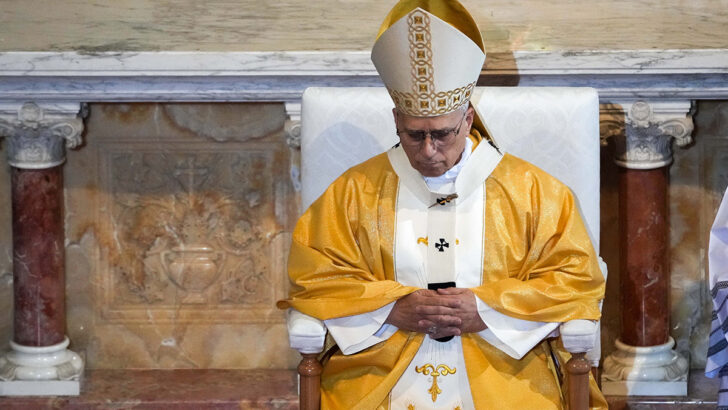
 Pope Leo XIV celebrates Mass at the Basilica of St Augustine in Annaba, Algeria, April 14, 2026. Photo: CNS/Lola Gomez.
 A Pope’s first encyclical is traditionally awaited with great anticipation – and this is now the case for Leo XIV as well. Church historian Jörg Ernesti explains what makes these particular doctrinal writings so special.
Monday is the day: Pope Leo XIV’s first encyclical will be published. And he will even present his encyclical, entitled “Magnifica Humanitas. On the Protection of Humanity in the Age of Artificial Intelligence”, in person, having already signed it on 15 May.
In doing so, Leo XIV is deliberately continuing an important tradition: exactly 135 years ago, on 15 May 1891, Leo XIII published his famous social encyclical “Rerum novarum”. In it, the Catholic Church addressed the consequences of the Industrial Revolution for society and morality in a comprehensive manner for the first time. This later developed into Catholic social teaching.
What is an encyclical – and why is it important?
As a form of papal pronouncement, the encyclical (Greek for ‘letter’) is still relatively recent, explains Jörg Ernesti, a church historian from Augsburg. The first of its kind, issued by Pope Benedict XIV, appeared in 1740 and dealt solely with a very internal church matter concerning the duties of bishops. The format only became a central instrument of papal teaching in the 19th century under Pius IX and Leo XIII, who together published around 130 such circular letters, according to the church historian.
Since these two popes took office in 1846 and 1878 respectively, one can also speak of an ‘inaugural encyclical’, Ernesti continues: ‘Since then, people have looked forward with anticipation to the first doctrinal letter from a new pope.’
The popes’ programme of government
‘For these first encyclicals can be compared to a kind of “manifesto”,’ the church historian continues. Whilst every pope assumes an office that is almost two thousand years old, he also brings his own personal stamp and theological priorities to bear. Moreover, encyclicals arise from a specific historical context and in response to concrete social challenges: ” In a sense, the new Pope pours out his heart here and presents his central theological concerns.”
In most cases, these first writings resembled a “theological sweep”, adds Ernesti. And for many popes over the last 180 years, one could indeed say that almost all the important themes that were to shape their pontificate were already hinted at in their first doctrinal writings.
“I find this particularly striking in the case of Paul VI,” explains the expert: “In his first encyclical, ‘Ecclesiam Suam’ (1964), he reflected on the theme of dialogue in all its facets – and then gradually put these ideas into practice during his pontificate.” But John Paul II’s first major document – “Redemptor hominis” (1979) – also revealed his entire view of humanity and his doctrine of salvation: “Anyone who wants to understand the popes must start with these documents.”
Pope Leo XIV took his time
Pope Leo XIV’s first encyclical had been eagerly awaited for some time. The fact that he has taken more than a year to issue his first encyclical since his election on 8 May 2025 is rather unusual. As Ernesti points out, with the exception of Paul VI, all modern popes have published their first encyclical more quickly.
In terms of content, Leo XIV has so far been rather cautious, the church historian believes. Particularly in comparison to his predecessor Francis, he has so far appeared more conventional and traditional. He has placed his clearest emphasis on issues of international politics – in calls for peace and humanitarian crises. In doing so, however, he is largely following the lines of Vatican diplomacy. “I think this restraint is entirely deliberate following his predecessor’s eventful pontificate,” says Ernesti: “It seems understandable to me that he is now bringing AI to the fore as a specific, current problem that he considers particularly pressing.”