

 Peter Costello
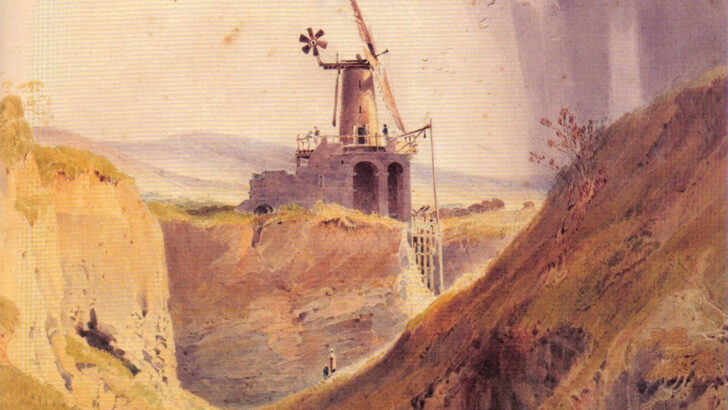 Early industry: The windmill at Rathgar quarry in 1831 by George Petrie, on the site of what
is now Rathgar Rark.
Early industry: The windmill at Rathgar quarry in 1831 by George Petrie, on the site of what
is now Rathgar Rark. Dublin’s Industrial Heritage: From Sandymount to Crumlin Road,
by Rob Goodbody
(Wordwell in association with Dublin City Council, supported by the Heritage Council, €17.99)
The Victorian novelist George Moore, himself a landed gentleman from Mayo, deprecated Dublin as an industrial city. Aside from a few streets and the nice houses of his artistic friends, the city was largely a squalid slum. That was because Moore, like so many people until a recent date, thought of an industrial city in terms of Birmingham or Glasgow, clearly very different from “dear dirty Dublin”.
Today Dubliners are happy to see the matter differently. Industrial Dublin, which George Moore reduced to a large brewery and couple of distilleries, can now be clearly seen for what it was. The past tense is appropriate as much of what was to be seen of the city’s industry has been swept away by housing and offices. It is researchers like Rob Goodbody who have opened our eyes to what can be seen or known.
This book, as the subtitle indicates, deals only with a portion of south-east Dublin; there may be more to come, but what is here is exciting enough.
Ten broad chapters deal with everything from mines and quarries to military installations, through mills, light industries like bakeries, heavy industries such as glass making and ship building, communications and utilities. Even just listing them shows just how extensive industrial Dublin was; it was not just a home for civil servants and administrators, the denizens of Dublin Castle and Merrion Street.
Detailed
This is a richly detailed survey. But some things, basic to modern city life, might well be first read about, such as the chapters on utilities dealing with street lighting, by gas and electricity, water supply and the often overlooked essential of drainage. These were the basic things that kept the city going, and even to this day anyone looking into an opening in the road opened up by city contractors will see the relics of earlier efforts from the last two centuries being slowly replaced by sets of yet more formidable blue plastic pipes.
Anyone reading this book will see their city in a very different light – even if the nighttime lighting of the inner-city streets leaves a lot to be desired”
However, citizens rarely think about where their water comes from – as long as they have it for “free” (which they can’t). Or after they have made use of it, where the waste goes. What really interests them, and a long section is devoted to this is transportation – getting to work and to the shops – in all its varied and fascinating aspects.
Anyone reading this book will see their city in a very different light – even if the nighttime lighting of the inner-city streets leaves a lot to be desired – have you been through Nelson Street on foot lately after dark?
The text is detailed and supported by notes and a bibliography. But a real joy are the wide range of cuts from early maps, drawings, prints and photographs, which are a real treat, showing the almost rural state of many now well built-up areas of South Dublin.
I think the south city will not seem the same to anyone who absorbs this book and makes use of it on their own explorations. Author Bob Goodbody is a building historian who has led many walks around the city and its environs. He knows exactly the things curious citizens want to know about. Altogether a great read, and an “Open sesame” to many of the city’s secrets.