

 Mary Kenny
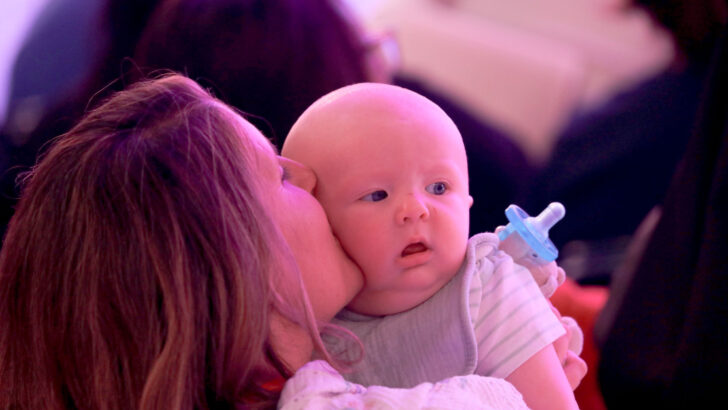 A mother kisses her baby. Photo: OSV News/Bob Roller
 In times gone by, most politicians were savvy enough not to attack motherhood. There was even a jokey phrase to allude to the sweetest things in life: “motherhood and apple pie”.
Everything else had a dubious side, but mom and apple pie occupied a specially valued zone.
Politicians of old grasped the point that everyone had a mother, and nearly everyone loved their mothers, and respected maternal devotion. So don’t underestimate the voting power of the Mammies!
But it sometimes seems that elected politicians are no longer in charge of the programme. That now seems to be delegated to outside unelected bodies, consultants, and NGOs.
Thus, the latest ‘Strategy for Women and Girls’, though promoted by the Government, and notably Minister Norma Foley, was in effect authored by the National Women’s Council of Ireland. This is an unelected body with its own agenda.
There are 17,164 words in two linked papers on women and girls’ roles, the blatant missing word is ‘mother’”
The NWCI sought to have the word ‘mother’ erased from the Constitution in 2024, unsuccessfully. Now, in their policy papers to support women and girls, they have again erased motherhood from the vocabulary.
The strategy paper is to improve opportunities for women in the workforce, and to protect women from violence and discrimination: good. To encourage more girls into STEM (science, technology, engineering, maths): good again.
But although there are 17,164 words in two linked papers on women and girls’ roles, the blatant missing word is ‘mother.’ (Acknowledgement: columnist Sarah Carey counted these words.) The gender-neutral ‘parent’ appears – but Mammy is gone.
Aspire
Not all women are mothers, and some do not aspire to be mothers. Generations of Irishwomen were educated by consecrated virgins – nuns who had chosen a vocation, a ‘calling’, rejecting the chance of marriage and motherhood.
But the majority of women do want to be mothers, and they should be supported in doing so. There is no contradiction between being a mother and being an engineer, and a genuinely progressive policy would enable young women to do both.
I don’t want them to think that their brainy ambitions rule out, or marginalise, a role that so many women find exhilaratingly fulfilling”
As it happens, exam results this summer have revealed my granddaughters excelling in chemistry and Maths. I am filled with delight at their achievements. But I don’t want them to think that their brainy ambitions rule out, or marginalise, a role that so many women find exhilaratingly fulfilling – being a mother.
Don’t let these ‘powers that be’ erase motherhood, and, by implication, our cherished memories of our mothers’ lives.
===
Comfort during controversy
We know that Ireland is becoming more secular – with a 30% drop in baptisms, as tracked by the Iona Institute.
Yet, when there is a local tragedy, it so often falls to the priest to offer care, and to conduct the funerals that follow.
It struck me how gracefully Fr Francis McCarthy carried out the funeral of 15-year-old Joe Carthy at St Michael’s Church Athy as Fr Tom Little did for Alex McCarthy, 16, at the Holy Family Church in Askea. A priest brought comfort to the family of Kamil Pustkowski, aged 17. And such pastoral care was evident in the two other funerals following.
These five teenage boys, who died in the terrible M9 crash in their stolen BMW, committed an appalling crime, and inflicted great harm on another family. Yet they were entitled to a Christian funeral, and the grace of God.
When a vigil was held for the Kinsella sisters and the little boy, again, Fr John Dunphy at St Clare’s Church at Graiguecullen did this so impressively.
To comfort the bereaved, maybe in controversial and tragic, circumstances, is not an easy role. I think no one else could fulfil this challenging role as well as the local priests
===

Why are people so fascinated with the return of Prince Harry, and his wife Meghan, to his family in Britain – much welcomed by his father, King Charles?
Harry and Meghan are international celebrities – that’s one reason.
But aren’t there echoes, too, of the parable of the Prodigal Son, told in St Luke’s Gospel, (Chapter 15, verses 11 to 32.)?
A certain man has two sons, an older and a younger. The younger leaves his father’s estate and “journey to a far land”, where he spends his inheritance. When he falls on hard times, his thoughts turn to returning home. And when he does so, his father greets him lovingly, places a fine robe on him, and orders a banquet.
But the older brother is angry and doesn’t want to be reconciled with his younger brother, who he feels has behaved badly.
The parallels with William and Harry are striking.
Royal correspondents claim that one reason Harry has returned to the fold is that he is running out of money, and career options.
Obviously, the parable is not just about a man who has two sons, one dutiful, one a scallywag: it’s about God’s forgiveness. But the story was told in this form because such things happen in families.