

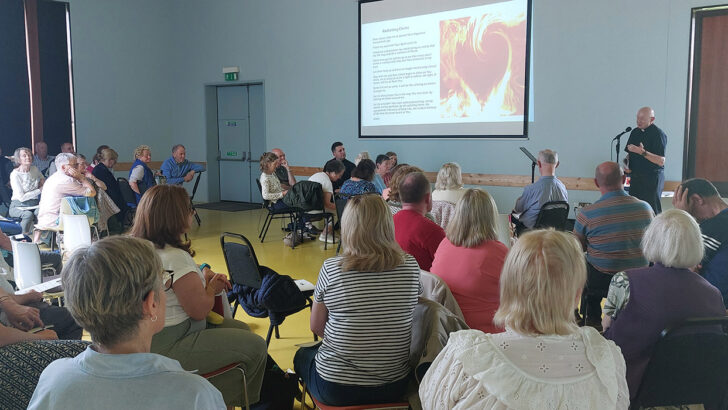
 One of the training sessions held in Dunshaughlin Pastoral Centre.
Diocese of Meath recently hosted four training sessions across the diocese to introduce members of Parish Pastoral Councils (PPCs) to the practice of ‘Conversation in the Spirit’ — a core methodology of the Church’s synodal journey. Organised by the Diocesan Synodal Team and facilitated by trained leaders who completed the Irish Synodal Pathway’s Facilitative Leadership Programme, the sessions aimed to foster a culture of prayerful listening and communal discernment.
The method of ‘Conversation in the Spirit’ gained global recognition during the universal synod in Rome, where it was used to ensure each delegate was truly heard, allowing space to discern the voice of the Holy Spirit through the community. In Meath, participants received not only training but a printed resource for conducting such conversations in their own parishes.
There was a genuine appetite for the training and a willingness to get involved”
Fr Declan Hurley, Chair of both the Diocesan and National Synodal Teams, praised the commitment of the over 180 PPC members who took part. “This training has the potential to be transformative for Parish Councils,” he said. “It will help us to shift away from the question, ‘what do we do?’ to the question, ‘what is the Spirit prompting us to do?’”
Fr Hurley also referenced Pope Leo’s emphasis on synodality as the movement of the Holy Spirit shaping the future of the Church. “This training is a key step for the Diocese of Meath in creating an openness to how the Spirit is shaping us into the future.”
The emphasis on communal discernment resonated with participants, who described the experience as hopeful, Spirit-filled, and deeply needed in today’s Church.
“There was a genuine appetite for the training and a willingness to get involved,” said Stephen, one of the facilitators. “The process of having Conversations in the Spirit, with its emphasis on active listening, openness, prayer and surrendering to the promptings of the Spirit, offers each person an opportunity for more meaningful engagement with others, leading to more fulfilling outcomes.”
Training
Anna, a pastoral worker, echoed the sense of encouragement: “As a method, it holds great promise for parishes discerning a way forward through the many challenges we face. Though change takes time, this process inspires genuine hope.”
Rosaleen, another facilitator, shared how the training allowed her to help members of Navan PPC engage with the Synod’s final document in a spirit of prayer and discernment. “I believe this training will empower PPCs across the diocese to discern how the Holy Spirit is calling them to implement their vision statements and advance evangelisation in their parishes.”
To deepen the theological foundation for this work, Fr Hurley recently preached on the mission of Parish Pastoral Councils”
Ruth, a participant in Dunshaughlin, said: “The absence of noise and asserting views, in place of a genuine desire to listen and understand what the Holy Spirit has to say through the gift of one another… it is a powerful witness that has filled me with great hope.”
To deepen the theological foundation for this work, Fr Hurley recently preached on the mission of Parish Pastoral Councils at a commissioning Mass in St Mel’s Cathedral, Longford. There, speaking of the first Pentecost, he said:
“The mission has begun! It has continued ever since. That same mission receives a new impetus as all of you – laity, religious, and clergy – are sent out in the power of the same Spirit that was poured into all of you at Baptism.”
Endgame
He reminded those gathered that the work of the councils must begin not with strategic plans, but with prayerful discernment rooted in Christ:
“Without Christ, it will be merely activism. Your actions and tasks as Parish Councils must always begin and end in Christ – in his Word, in his mission of salvation, in the mystery of his love.”
Ultimately, the new training in Conversation in the Spirit and the commissioning of PPC members across the country point to the same reality: the Church in Ireland is entering a new chapter in which shared leadership, prayerful listening, and discernment are not peripheral, but central.
As Fr Hurley put it, “Your Parish Pastoral Councils must become the places where clergy, laity – and religious where present – learn the art of being a leadership body at the service of the mission of the Church.”
Your actions and tasks as Parish Councils must always begin and end in Christ – in his Word, in his mission of salvation, in the mystery of his love”