

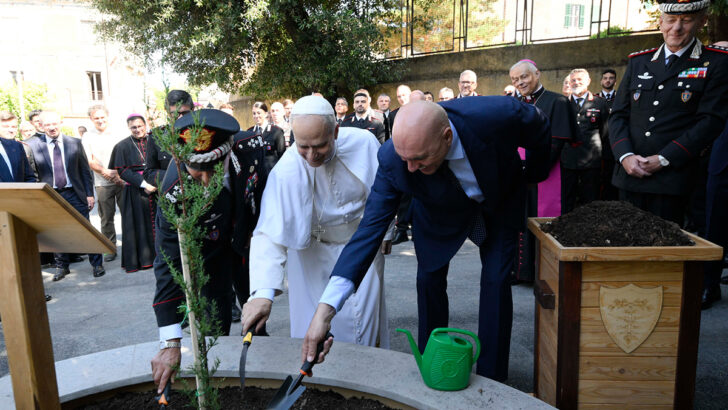
 Pope Leo XIV joins the Italian
Carabinieri to plant a young
cypress grown from the ancient
Cypress of St Francis at Castel
Gandolfo — a sign of renewal,
rootedness, and the Church’s call
to care for creation on the synodal
path. Photo: CNS /Vatican Media.
Pope Leo XIV joins the Italian
Carabinieri to plant a young
cypress grown from the ancient
Cypress of St Francis at Castel
Gandolfo — a sign of renewal,
rootedness, and the Church’s call
to care for creation on the synodal
path. Photo: CNS /Vatican Media. The Synodal Pathway is God’s invitation to all of us – the baptised – to enter into a process of conversion and renewal as a pilgrim people. It prioritises communion, participation and mission rather than “organisational expediency” (Final Document 44), asking us to listen to the Spirit which requires attention to Scripture, the sensus fidei (the sense of the faith) of the whole of the People of God but especially “those whose wounds continue to bleed in the world” (FD 2). The Synodal Pathway has acknowledged the Church’s commitment to inclusion and solidarity through the centuries, while recognising the need for a greater awareness of the Church’s Social Teaching.

The Bishops’ Council for Migrants, Refugees, Justice, and Peace, and Trócaire have promoted the Church’s Social Teaching while advocating for those who are excluded from society. In the past, we have fallen into the danger of distinguishing between the Church and those who are on the margins as “them” and “us” where we speak on their behalf. The Synodal Pathway calls for the actual participation of those on the peripheries rather than just talking about them. They must be active participants in our communal discernment as a synodal Church, as an incarnational Church embedded in the life of the community. It listens to people as they express their pain, is open to communal discernment, and to the voice of the Holy Spirit. The Synodal Church is one that is “marked by unity and harmony in pluriformity” (FD 43). This requires conversion.
Good work has been done in parishes by Laudato Si’ groups in promoting Pope Francis’ bestselling encyclical letter Laudato Si’ (2015). Yet, we need to ask ourselves how integral has it been in our daily lives? We must stop living as if the world was an endlessly adjustable one and move away from capitalism to a simpler lifestyle. The Synod on the Amazon (October 2019), initiated by the late Pope Francis – called on the Church to break with the European legacy of colonial extraction and exploitation, opening the Church to learning from cultures outside of its European heritage.
Today in Ireland we have people who have had to seek refuge and asylum here because of the effects of the European legacy of extraction and exploitation. We are being invited to actively listen to their experiences, so we can challenge the misinformation, which fuels hatred and racism in our localities. We are called to embrace diversity and build communities of inclusivity. Jesus never sent anyone away without stopping to listen and to speak to them, whether men or women, Jews or pagans, doctors of the law or publicans, righteous men and women or sinners, beggars, the blind, lepers or the sick (FD 51). We need to maintain the dynamic tension between the Church’s prophetic denunciation of injustice and its advocacy for policy change with policymakers.
There are other types of exclusion and marginalisation that have occurred both inside and outside the Church. The abuse crisis, in its many forms, sexual, spiritual and economic, is still an open wound that continues to call for a deep listening, healing and reconciliation (FD 55). While the Final Document (60) lists ways in which women do participate in the Church, the very manner of this listing suggests that these are ways in which women are ‘allowed’ to participate in Church activities. This permission comes not from the working of the Spirit, but from the decisions enshrined in Canon Law by the male hierarchy. The question of women’s access to diaconal ministry remains open. We must let ourselves be surprised by the Holy Spirit whose work cannot be stopped.
A Synodal Pathway does not mean we only work with others within our own faith contexts. As a member of Dublin City Interfaith Forum, I appreciate the value of walking together, fostering dialogue and mutual understanding. Dialogue, encounter and exchange of gifts, typical of a synodal Church, are calls to open out to relations with other religious traditions (FD 41). Pope Francis in Abu Dhabi (February 2019), when signing the Document on Human Fraternity with the Grand Iman of Al-Azhar stated “there is no other alternative. We either build the future together or there will not be a future.”
The Synodal Pathway must be rooted in the sacred communion of all creation and in the lived values of diversity, interdependence, inclusion, mutuality, radical hospitality, equality, and collaboration. The only way this can happen is with investment in “proper formation” (FD 141) with the “presence of suitable and competent formators” (FD 143) if we are truly to become a synodal church.
A Synodal Pathway is a process which is Gospel centred. It is about all of us and demands change, which is always messy and difficult but, as missionary disciples of Jesus, this is what we are being called to do at this time in our history.
Dr Sheila Curran RSM is a member of the Council for Migrants, Refugees, Justice, and Peace of the Irish Bishops’ Conference.