

 Peter Costello
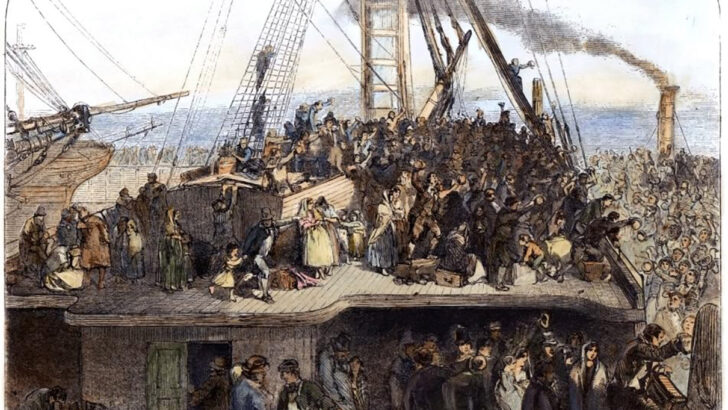 Life on board an emigrant ship at sea c. 1850.
 Passage to America: the story of Ulster’s emigrants
Taking ship: Essays in transatlantic migration from Ulster,

edited by Sophie Cooper, Patrick Fitzgerald and William Roulston
(Ulster Historical Foundation, £11.99 / €13.99)
Felix
M.
Larkin
***
An Post has recently marked the 250th anniversary of the American Declaration of Independence with a stamp featuring a portrait of the printer of the first copies of the Declaration, John Dunlap, who was born in Strabane, Co. Tyrone, in 1746.
The stamp gave rise to some controversy in Northern Ireland, with objections from certain quarters to An Post laying claim to an American of the Scotch-Irish tradition.
That tradition – with its roots in 18th century Presbyterian migration from Ulster – dominates the popular narrative of transatlantic migration from Ulster.
This collection of essays explores aspects of the tradition, but also seeks to broaden our understanding of it by questioning – to quote from the Introduction – “why Famine and post-Famine emigrations have become an Irish story, often with Ulster experiences excluded, while pre-Famine emigration has become an Ulster Presbyterian story, excluding non-Presbyterian Ulster experiences and Ireland more widely”.
Prof. Audrey Horning addresses these questions in an essay surveying recent scholarship on connections between Ulster and America. She notes that “the Scotch-Irish became the Scotch-Irish after the fact, when it became crucial to distinguish Protestants of Irish origin from Catholic Irish migrants”.
Narrative
The exigencies of forging a distinct Scotch-Irish identity in America may help to explain how the popular narrative of transatlantic migration from Ulster took hold. She suggests that a further factor in shaping that narrative is the denial – largely for reasons of political expediency – of the extent of the Great Famine in Ulster.
The impact of the Famine on rural mid-Ulster is captured in Dónal McAnallan’s essay on the assisted emigration scheme arranged by the trustees of the Powerscourt estate in Benburb, Co. Tyrone, in 1849. Some 200 small farmers and their families were sent out to New York.
McAnallan comments that the scale of this scheme “dispels any idle notion that the northern heartlands escaped the ravages of An Gorta Mór”. An essay by Rankin Sherling demonstrates how devastating the Famine was to Ulster’s Presbyterian population.
A theme linking many of the essays is the means by which migrants actually accomplished their journey. There were three stages: leaving home and travelling to a port in Ireland; crossing the Atlantic; and disembarking in America, with possibly an onward journey westward from the port of arrival.
With links to the rest of the world, Liverpool became part of the tragedy of the Famine”
In some instances, there was a subsidiary stage as the migrant might first travel to Liverpool and then sail from Liverpool to New York. In her essay on “how multinational corporations decide where and how we migrate”, Christina A. Ziegler-McPherson records that by 1836 nearly 90% of the Irish arriving in New York had departed from Liverpool.
The importance of Liverpool for the Irish fleeing the Famine – “either as a place of refuge, a gateway to other parts of England, or as a port of departure to the rest of the world, but primarily North America” – is discussed in an essay by the doyenne of Irish Famine historians, Christine Kinealy. Kinealy explains that, as the leading port in Britain, with links to the rest of the world, Liverpool became part of the tragedy of the Famine.
Travel
Already struggling with its own social issues, Liverpool’s Poor Law system was overwhelmed by the influx of Irish migrants. Even those travelling on to North America or elsewhere usually spent between 48 hours to three weeks in the city waiting for a sailing, and had to be accommodated during that period.
They were also a source of employment, as the railroad companies aggressively recruited immigrant workers”
The emigrants’ journey to a new life in America was greatly facilitated by the coming of the railway, and Ron R. Roach contributes a fascinating essay about the role of railways in Ulster and Appalachian emigration.
He writes: “Before 1850, emigrants primarily walked or, if lucky, rode in a horse-drawn cart to their ports of departure. After 1850, trains were the primary mode of transport.”
In America, railroads not only “provided transportation for immigrants as they spread out into the American interior, but they were also a source of employment, as the railroad companies aggressively recruited immigrant workers”.
This interesting and attractively-presented volume comprises 18 short essays that are adapted from papers given at the 24th Ulster American Heritage Symposium hosted by the Mellon Centre for Migration Studies at the Ulster American Folk Park in 2024.
Appropriately, it includes an essay by Peter Gilmore on Thomas Mellon, the quintessentially Scotch-Irish patriarch of the hugely successful Pittsburgh family who endowed the Centre. Curiously, Thomas Mellon in 1880 joined other Scotch-Irish Pittsburghers in formally welcoming the Irish nationalist leader, Charles Stewart Parnell, to the city. Gilmore speculates that this may indicate a certain ambiguity in the apparently-robust American Scotch-Irish identity.
John Minihan, a talent in black and white
Visual Poetry: The Photography of John Minihan,
curated by Sarah McAuliffe
National Gallery of Ireland: Sir Hugh Lane Room (Room 31) runs until October 11, 2026. Entrance free.
Peter
Costello
***
I first became aware of John Minihan as a photographer when I lived in London in the early 1970s. He was then a very visible photographer with the Evening Standard, which was very much my paper. I then shared a flat with my older brother who worked in the city and took in a set of morning papers which I assiduously read for the news.
But for getting about one needed to read Time Out and the Evening Standard. John Minihan was very much an imaginative presence. He had won an Evening Standard competition at the age of 15 with an astonishing photograph of the ‘Whispering Gallery’ in St Paul’s. By the time he was in his early 20s he was the youngest staff photographer on the paper.
His images then appeared, of course, in what was called monochrome; but as he rightly pointed, “Black and white are the only colours of photography”.
This show illustrates every stage of his work. He was not only a lens man about London. Every year he went home to his native Athy in Kildare, where he had been photographing since he was 16.
Photographs
A central feature of this show are some of the photographs he published from a suite of images concerning the wake and funeral of a local lady, which was only a small part of his output. These images were collected in an album called Outside the Pale: Portrait of an Irish Town.
But he also specialised in the portraits of writers, mostly Irish, among them Beckett, Edna O’Brien and John Montague. A curiosity of this show are his images of other image makers: not just Hockney and Francis Bacon, but also Cecil Beaton and Richard Avedon, people famous for their talents in creating forceful images.
His photograph of Samuel Beckett taken in a Parisian cafe in 1995 has become iconic. One of Beckett’s publishers, John Calder, remarked of Minihan’s portrait: “the introspective, infinitely sad gaze of a man looking into the abyss of the world’s woes”.
He has been photographing the relics of another day, fragments of Irish life in his youth”
An album of his photographs was published as Photographs: Samuel Beckett in 1995. Images of other Irish writers appeared in another album An Unweaving of Rainbows: Images of Irish writers (1996).
But of late he has been photographing the relics of another day, fragments of Irish life in his youth. What is on show at the National Gallery gives a taste of the range of his insight into personalities of writers and to the identity of places.
There are also images of his coverage of the now abandoned County Home in Athy, an institution of a kind which has now vanished, but which recovers a feeling for Ireland in the 1950s that many will have tried to forget and young people never know.
Special prize Medal awarded to Desmond Eagan
In the course of the official opening of the Hopkins International Literary Festival this year Kildare County Council honoured the director of the festival, the poet Desmond Egan with an award in recognition of his distinguished contribution to literature and to the cultural life of County Kildare and Ireland.
The Civic Honour was in the form the “Dara Bronze”, a limited-edition civic coin commissioned by Kildare County Council.
Desmond Egan has not only managed to establish and continue the festival honouring one of the greatest poets to have lived in 19th century Ireland, but has developed it into something of permanent benefit to Irish culture, concentrating as it does on poetry and philosophy in a richly rewarding way which illustrates the continuing importance of religion in human culture.
One’s own place in the wider world
Fireside Miscellany, Cuid a Dó: Memories, Meandering, History
and Lore,
by Denis O’Higgins
(Published by the author, €10.00 /£10.00 or €14.00 /£13.00 incl. postage; the profits to be donated donated to the mental health charity SOSAD; contact dohiggins43@gmail.com)
Peter
Costello
***
The old Irish saying “Nïl aon tinteán mar do thinteán féin.” is only too true of us all.
We are most content when we are mixing with our own folk and neighbours in our own place. And yet, as was once said of a once famous newspaper, “all human life is there.”
Denis O’Higgins, the author and publisher of this book of little narratives, is a Roscommon man, and the tales he has to tell are mostly from the days of his own younger years in the 1950s and 60s. In addition, included in the book are stories by his wife Josephine, who will be familiar to some from her contributions to RTÉ’s Sunday Miscellany.
He opens the book with a piece on a local character, Paddy Clarke, who was a personality around the town of Monaghan, selling combs and razor blades, a small trader not a beggar. But his stability had been upset by an experience in the Great War when the troop ship he was on was sunk while crossing the Mediterranean off the Egyptian coast. This was a once famous episode, but is now quite forgotten (though there is, as I recall, a display about it in the Irish Maritime Museum).
But the book as whole is a ripe collection of personal experiences, encounters and reflections to which he has added tales from the past which he has assiduously researched.
Tales
There is a piece on “the Missing Policeman case” from Wexford in 1929 – a still a strange affair. But there are lighter tales too, such as his evocation of the gents in peaked caps with an official badge on their lapel who used to haunt central Dublin, helping people to park their cars, when cars were just becoming commonplace.
They are as much a part of a vanished past as their counterparts who used to collect the charge for using the deck chairs that once graced St Stephen’s Green. Equally engaging is the tale of what became of a film maker’s boarded up house on Tory Island while he was away working in the Antipodes.
There is on the whole a very homely air about the whole book which makes it well worth reading”
This book then is a most agreeable mixture, not of just bits and pieces, but of episodes that are enjoyable to read about, and to ponder over later, as they carry curious insights in the way people live. And though the materials are drawn from travels and encounters from his own place there is on the whole a very homely air about the whole book which makes it well worth reading.
For a summer reading or winter reflection this will prove a most attractive volume. Such local books always bring to my mind those lines of Patrick Kavanagh, another local man:
…I inclined
To lose my faith in Ballyrush and Gortin
Till Homer’s ghost came whispering to my mind.
He said: I made the Iliad from such
A local row. Gods make their own importance.
SOSAD Ireland (Save Our Sons and Daughters) is a charity that provides free mental health support, suicide prevention services, and a 24/7 helpline. It is community based service, volunteer-led organisation that relies on public donations and does not receive direct core state funding. Readers can learn more or reach out for support directly through the SOSAD Ireland Official Website.