

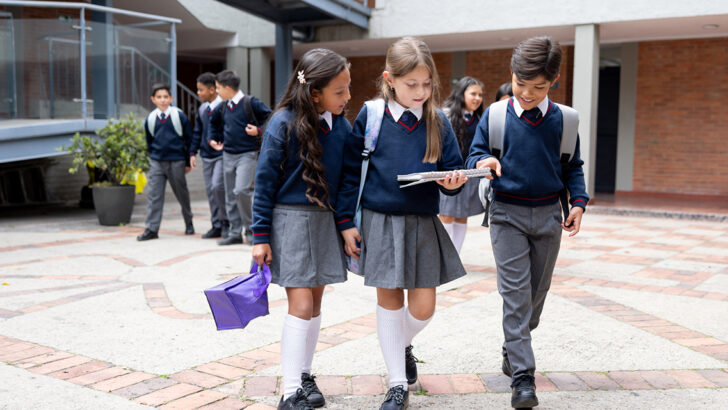
On most weekday mornings, in cities, towns and rural parishes alike, a familiar scene unfolds at the school gate. Parents gather in small groups, exchanging brief greetings before the day pulls them in different directions. Children weave between conversations, balancing schoolbags and last-minute reminders. In those few unremarkable minutes, people who might otherwise rarely cross paths; neighbours and newcomers, families with different backgrounds and outlooks; stand side by side, united by the shared rhythm of the school day. It remains one of the places where Ireland encounters itself in ordinary, human ways.
For generations, schools have occupied a central place in Irish community life. They mark the passage of time, from a child’s anxious first day to the bittersweet final assembly. Long after formal schooling ends, many people retain an attachment to the place where they first learned to read, to play and to belong. In smaller communities especially, the local school is more than an educational institution; it becomes part of the memory and identity of the place itself.
Settings
The settings in which people meet have changed. Local shops have closed or changed hands, post offices have reduced services, and much of daily life is condensed and can now be conducted online. Schools are certainly not alone in bringing people together. Sports clubs, libraries, community groups and voluntary organisations remain vital meeting places. But schools have one unusual characteristic: they bring people back to the same place, at roughly the same time, day after day and year after year.
That repetition matters. At concerts, matches, fundraising events and meetings, parents, grandparents, teachers, neighbours and volunteers encounter one another in ways that are often unplanned and unremarkable. Conversations begin with practical matters and sometimes grow into friendship or support. At the gate itself, relationships can begin more simply still; through recognition, a greeting or the gradual familiarity that comes from seeing the same faces each morning. The school becomes not just a place children attend, but somewhere adults repeatedly encounter one another because their children share a community.
Where populations are dispersed and distances long, the school may be one of the relatively few places where a broad section of the local community gathers regularly”
Schools do not erase the divisions that exist beyond their gates, and no individual school reflects Ireland in all its diversity. Communities themselves can be shaped by geography, housing, income and parental choice. Nor will everyone experience a school community in the same way. Yet schools can still create something valuable: sustained contact among people who may not share the same background, outlook or experience. Difference is encountered not as an abstract social question, but through the ordinary business of living alongside other people.
In rural areas, this role can be particularly visible. Where populations are dispersed and distances long, the school may be one of the relatively few places where a broad section of the local community gathers regularly. Its significance can therefore extend beyond what happens during lessons. When circumstances around a school change, the effects can also be felt beyond its pupils and parents because a familiar point of encounter and shared activity changes with it.
Urban schools perform a similar function in different circumstances. In neighbourhoods where populations and housing patterns change quickly, the school can provide continuity amid movement. Families arrive and depart, but relationships form through the routines surrounding school life. As Ireland becomes more diverse, schools are among the places where that change is experienced in everyday encounters between children and adults rather than simply discussed at a distance.
Idealise
None of this is to idealise schools or suggest that they should compensate for every change in community life. Schools have pressures and divisions of their own. Their first responsibility is, and must remain, the education and wellbeing of children. But their wider role can be easy to overlook precisely because it appears so ordinary. The school gate, the match, the concert or the hurried conversation at collection time rarely looks like anything of wider significance. Often, it is simply people getting on with the day.
And perhaps that is the point. People do not have to agree with one another, share a background or even choose one another’s company. They simply keep meeting because their children attend the same school. Over time, those encounters can produce familiarity and the practical habit of living alongside people who are not exactly like ourselves. It is a modest form of citizenship, learned less through instruction than through experience.
Reverse
By the afternoon, the gate will open again and the ritual will repeat itself in reverse: parents waiting, children spilling out with stories of the day, conversations resuming as naturally as they paused that morning. Nothing about the scene will appear remarkable. A greeting will be exchanged, a conversation carried over from the morning, perhaps a new face recognised for the first time.
Then the yard will empty and everyone will go their separate ways.
But tomorrow, they will meet again.
David Brennan works in primary education, is a PhD candidate at the University of Limerick and serves as a Peace Commissioner in Co. Galway.