

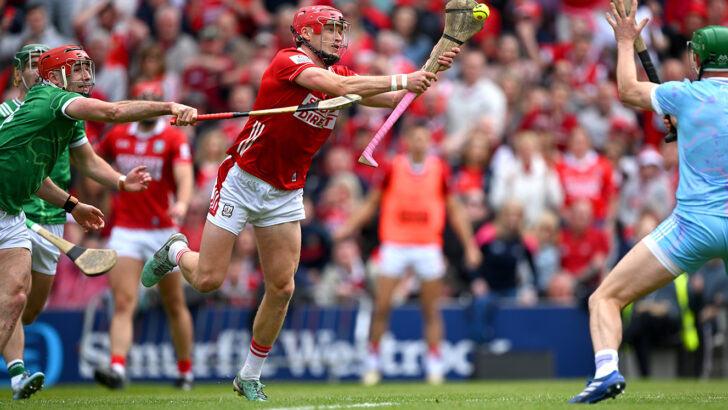
 Alan Connolly of Cork shoots past Limerick goalkeeper Nickie Quaid to score a goal despite the presence of Barry Nash of Limerick during the Munster GAA Senior Hurling Championship Round 2 match between Cork and Limerick at SuperValu Páirc Uí Chaoimh in Cork, April 26, 2026. Photo: Ray McManus / Sportsfile.
 For much of the past decade, Limerick’s dominance has cast a long shadow over Munster hurling. Six consecutive provincial titles under John Kiely’s reign established a level of dominance rarely seen in the modern game, with the round-robin series producing blockbuster encounters that remarkably more often than not still ended with the same outcome for the Shannonsiders.
Yet even at their height, the margins were never as comfortable as the silverware might suggest. Since the introduction of the round-robin format in 2018, and particularly following their breakthrough provincial title a year later, Limerick have been pushed relentlessly. In recent seasons, that pressure has begun to tell.
Cork’s dramatic victory in last year’s Munster final did more than end a run of provincial titles; it punctured the sense of inevitability that had come to define the Green Giants, something that had wavered since Cork halted their drive for a fifth successive All-Ireland in 2024.
Shift
In truth, that shift had been coming. Cork have now won four of the last five championship meetings between the sides, with almost every contest decided by the narrowest of margins with the exception of Limerick’s 3-26 to 1-16 last season round-robin victory, which had all the hallmarks of a revenge mission for the year before.
The turning point came in 2024 during Cork’s must-win round-robin clash on a glorious summer evening on the banks of the Lee. The Rebels, facing elimination, somehow found a way with a last-gasp penalty from Patrick Horgan sealing a dramatic victory and reignited belief in the southern capital. From that moment, the balance began to tilt. Weeks later, Cork struck again in Croke Park, ending Limerick’s bid for history and confirming that the gap between the sides had closed decisively.
That pattern has continued into this season. Limerick still carry the traits of a great side, injected with a sprinkling of youth, but no longer have the aura of invincibility they once did. Even when they surged into an early lead in Páirc Uí Chaoimh last month, a Cork response felt inevitable rather than improbable. The momentum shifts quicker now, the control is more fragile, and once it turns, it is harder to wrestle back.
Shane Barrett’s twentieth-minute goal came as a result of a cheap turnover, the kind of lapse that would have been unthinkable at Limerick’s peak, and Cork needed little more than that single spark to roar back into life. The decisive spell followed soon after the restart, with Alan Connolly’s goal and captain Cian Lynch’s foolish red card arriving within minutes of each other, ultimately proving to be the difference.
Moments
Moments like these tell their own story. Where once Limerick’s dominance was built on control and precision, there seems to be somewhat of a growing sense of vulnerability creeping in, be it small lapses, poor shot selection or brief losses of discipline, the kind that simply did not exist during their most dominant years.
Liam Cahill’s side looked in complete control, only for that authority to unravel over the course of a chaotic second half”
The loss of Cian Lynch and Aaron Gillane, arguably the defining players of this era in their respective positions, was one Limerick could not absorb. Even with Diarmuid Byrnes’ late, somewhat fortuitous goal briefly restoring their advantage, Cork finished with greater composure and clarity to secure a two-point win.
It was a similar story in the south-east, where Tipperary’s All-Ireland defence already appears to be hanging by a thread. Leading by eleven points at half-time in Walsh Park, Liam Cahill’s side looked in complete control, only for that authority to unravel over the course of a chaotic second half. Waterford dragged them back score by score before Kevin Mahony’s late goal salvaged a draw that felt as much psychological as it was practical.
Underline
Both games underline the same point. In Munster, control is fleeting. Leads are fragile, momentum shifts quickly, and even the most established forces can find themselves exposed within minutes. For Tipperary, after an opening defeat to Cork, the margin for error has already all but disappeared with Clare and Limerick still to come.
What once felt permanent no longer does. The certainty and feeling of invincibility that defined Limerick’s reign have given way to something far more dramatic and unstable, and that shift is not just confined to Munster.
Across the provinces, established hierarchies are being challenged and, in some cases, overturned entirely. Donegal’s push for a third successive Ulster title was halted abruptly by Down, a result that underlined just how little room for error, or space for being a per cent off, now exists at the top level.
Roscommon’s victory over Mayo did not carry the same sense of surprise, but its significance may yet prove greater”
The defeat was not simply a shock but a reflection of something deeper. For all Donegal’s structure and control under Jim McGuinness, they were exposed by a Down side that played directly with pace and belief. Down’s victory in O’Donnell Park, their opponents’ first championship game in the Letterkenny since 1951, will go down as one of the results of the season so far. Conor Laverty’s side struck for three decisive second-half goals through Daniel Guinness and Miceál Rooney, while Pat Havern’s accuracy and their relentless energy caused Donegal problems throughout.
If Ulster provided the shock, Connacht delivered something more definitive. Roscommon’s victory over Mayo did not carry the same sense of surprise, but its significance may yet prove greater. For much of the past decade, Mayo and Galway have operated as the province’s dominant axis, with the rest cast largely in supporting roles.
Roscommon’s intervention disrupts that pattern in a far more meaningful way, not as a one-off result, but as a statement that the established order can no longer be relied upon. Their dismantling of Mayo in Castlebar raised uncomfortable questions for a side that, only weeks ago during a strong Allianz league campaign, appeared capable of competing with anyone in the top tier. Now, uncertainty surrounds them once again.
Even Galway, who ultimately progressed, were pushed to the brink by Leitrim. Having already seen off neighbours Sligo in the quarter-finals, their first win over the Magpies in fifteen years, the O’Rourke County produced another spirited performance in Carrick-on-Shannon, forcing Galway to dig deep before the Tribesmen eventually pulled away for a five-point victory.
Significance
That context only adds to the significance of the display. Leitrim had finished second from bottom in Division Four of the Allianz League, with only Waterford ranked below them, yet they matched one of the province’s dominant sides for long stretches. Manager Steven Poacher was quick to highlight that disparity afterwards, calling for greater respect for his players.
“I felt we were disrespected coming in here; some of the punditry, some of the media coverage around it, some of it was very derogatory,” he said. “These young lads showed that they were close; every one of them executed the game plan to the letter of the law.”
On paper, the result changes little, but in reality, it says plenty. In a championship where momentum shifts quickly and margins are increasingly unforgiving, even the most predictable outcomes now carry an edge of vulnerability.
Munster football, at first glance, appears to resist that trend. Kerry’s path to another provincial final has unfolded with familiar ease, their dominance of the province, twelve titles in the last thirteen seasons, turning expectation into routine. In that sense, Munster remains the last stronghold of certainty.
Yet even here, the gap may not be as secure as it once seemed. Cork’s narrow two-point defeat in last year’s semi-final to the Kingdom, a game in which they were given little chance, hinted at a distance between the old foes is no longer unbridgeable. Under John Cleary, the Rebels have steadily rebuilt, returning to Division One and rediscovering a level of competitiveness that had appeared to allude them.
Kerry, driven by the brilliance of David Clifford and with their sights set firmly beyond the province, will still enter as overwhelming favourites, particularly on home soil in Killarney. But familiarity does not guarantee control. The Kingdom may dominate Munster, but they continue to bring the best out of Cork, and there is a growing sense that this rivalry is no longer quite as one-sided as the recent record books suggest.
Conversations around restructuring the championship surface each year, particularly when comparing Leinster’s uneven competitiveness”
If Munster football still leans toward predictability, Leinster hurling presents a different kind of imbalance altogether. The province appears increasingly split in two: Galway, Kilkenny and Dublin operating at one level, with Wexford, Offaly and Kildare chasing from another.
There are occasional disruptions. Dublin were held to a hard-fought draw by Offaly, a result that underlined the Faithful County’s progress, but the broader pattern remains difficult to ignore. Kilkenny responded to their own setbacks by easing past Wexford, while Galway exposed the gap further with a comfortable win over Offaly. On most weekends, the hierarchy holds.
That imbalance feeds into a wider concern within the game. Conversations around restructuring the championship surface each year, particularly when comparing Leinster’s uneven competitiveness with the week-on-week intensity of Munster. Yet the reality is unlikely to change. The Munster championship, with its packed grounds, economic pull and relentless drama, is too valuable, both culturally and financially, to dilute.
Concern
The deeper concern lies not in structure alone but in trajectory. Counties like Wexford, once central to the championship conversation, now risk drifting down the ladder. It would have seemed unthinkable not long ago that Kilkenny could suffer heavy defeats in such a short span, yet even they have shown signs of vulnerability, particularly against Galway. Their response against Wexford was emphatic, but it did little to quiet the broader unease.
For Wexford in particular, the questions feel more pressing. Lee Chin has carried the side for much of the past decade, with Conor McDonald offering support on the scoring front, but the core of this team still traces back to the Leinster under-21 successes between 2013 and 2015. As that generation edges on, there is uncertainty about what follows. Without renewal, the gap risks widening further, and in a championship increasingly defined by fine margins at the top, that kind of drift can be difficult to recover from.
At the opposite end of the spectrum, Galway are beginning to gather momentum in the other direction. Under Michael Donoghue in his second spell, they already look a far more complete and assured side than they did this time last year, and their dismantling of Kilkenny twice already this year has sent an early statement through Leinster.
Yet even that comes with a caveat. Should those sides meet again in a provincial decider or beyond, it is unlikely to resemble anything so straightforward. Kilkenny rarely allow narratives to settle, particularly negative ones, and those hammerings will matter for little once silverware is on the line and the Cats are in a provincial or national final.
Already, even just a matter of weeks into the summer, certainty has already eroded. Limerick are no longer alone in that regard. Across both hurling and football, and in every province, the opening weeks of the championship have revealed a clear pattern of genuine jeopardy.
If Munster hurling once stood apart for its intensity and unpredictability, it now feels more like a blueprint for the game as a whole”
The results so far this year point to something larger. What once felt like isolated shocks are starting to look like part of a wider shift. The championship is no longer defined by certainty at the top but rather by pressure from beneath.
If Munster hurling once stood apart for its intensity and unpredictability, it now feels more like a blueprint for the game as a whole, with its attrition, fanfare and potential for upsets no longer confined to one province or one code. And perhaps that is the defining story of this summer so far: not the fall of any one team, or the rise of another, but the disappearance of certainty itself.
When reputation counts for less and narrow margins matter more, no result feels secure until the final whistle, as the edge of the championship summer has not dulled; it has only sharpened.