

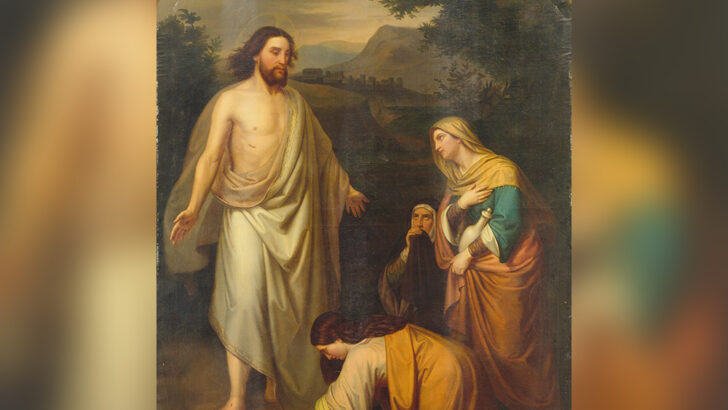
 ‘Appearance of the Resurrected Christ to Women at the Grave’ by Joaquin Ramirez. Photo: OSV News / Mary Chalupsky, courtesy Knights of Columbus Museum.
 “We are an Easter people.” So began a remarkable day of reflection at St John of God Sisters’ Retreat Centre in Ballyvaloo, Co. Wexford recently. The theme was both simple and challenging: ‘Celebrating the Radical Easter Message of Liberation for Women’. The facilitator was Gráinne Doherty, from Donegal, a woman who brings rare gifts of scripture scholarship, pastoral insight, and quiet passion to her work of connecting faith with lived experience.
Of the sixty-five people gathered in that sunlit space in Wexford, only two were men. I was glad to be one of them.
Honest
Let me be honest from the outset. This was not a radical feminist rant. There was no agenda-driven clamour for women’s ordination. What there was — and it proved far more unsettling — was a careful, scripture-rooted reflection on how women have been, and continue to be, marginalised in the life and governance of the Church. As I listened, I recognised something I have believed for a long time: the voice of women is not adequately heard in our Church — not in its teaching, tradition, or decision-making. And the Church is immeasurably poorer for that silence.
Gráinne opened the scriptures with a sure and gentle hand. The image that stayed with me longest came from Luke’s gospel — the woman bent double, unable for eighteen years to straighten herself and see the world at eye level. Her whole vision was determined by her condition. When Jesus heals her, a new world literally opens before her. She stands upright. She sees differently. How many women in our Church are still bent over, their gifts unseen, their voices unheard, their perspective excluded from the rooms where decisions are made?
One observation from the day has stayed with me above all others. In the Easter Gospel, it is the women who go to the tomb. It is they who first discover that the stone has been rolled away. It is they who are entrusted with the first announcement of Resurrection. And yet, at the Easter Vigil, when that same Gospel is proclaimed in our churches, those same women could not be the ones to proclaim it liturgically. I understand the rubrics. I know the tradition. But surely, we must feel the ache of the contradiction. The women who first carried the Easter message are still, in too many ways, waiting for the stone to be rolled away.
The final document of the Synod on Synodality, approved by Pope Francis in October 2024, offers genuine grounds for hope. The Synod called for women to be welcomed into every role currently permitted by canon law and for greater participation of women in decision-making. These are hopeful words. They need now to become hopeful deeds.
Anchoring
The Easter image anchoring all of this is the stone rolled away from the tomb. It is the central act of liberation in the Christian story. Gráinne put it plainly: for too many women, that stone has not been rolled away. Their gifts remain entombed, their voices sealed in, their leadership potential buried beneath centuries of institutional habit and theological caution.
I drove home through the Wexford countryside thinking that the Church I love still has a stone to roll away. And I found myself praying — honestly, urgently — that we would find the courage to roll it.
Every little helps!
A divorce court judge said to the husband, “Mr Geraghty, I have reviewed this case very carefully and I’ve decided to give your wife €800 a week.” “That’s very fair, your honour,” he replied. “And every now and then I’ll try to send her a few euros myself.”
From ‘Don’t Quit’ by Edgar Albert Guest
…Life is queer with its twists and turns.
As everyone of us sometimes learns.
And many a fellow turn about when he might have won had he stuck it out.
Don’t give up though the pace seems slow – you may succeed with another blow…
Success is failure turned inside out – the silver tint of the clouds of doubt,
and when you never can tell how close you are,
it may be near when it seems afar;
so stick to the fight when you’re hardest hit – it’s when things seem worst, you must not quit.