

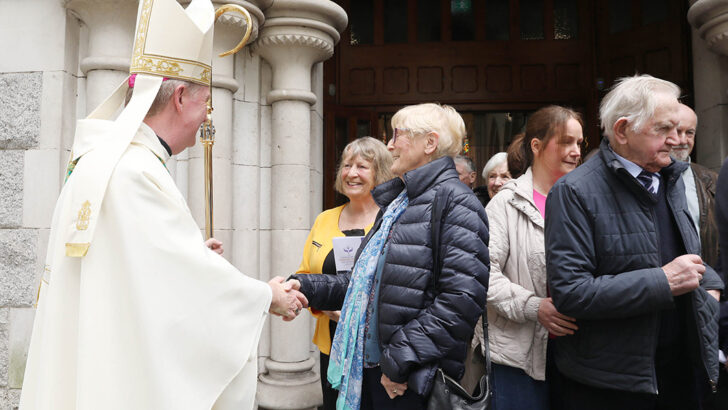
 people on April 27, 2025, after Mass marking 150 years since the laying of the foundation stone of the Church of the Annunciation in Rathfarnham, Dublin. Photo: John McElroy.
Douglas
Vandergraph
The Sunday handshake can mean a great deal to someone entering a parish for the first time. It can break a small wall of uncertainty and reassure a visitor that they have not intruded. But the quality of a welcome is tested more fully a week later, when the visitor has a question, a practical difficulty or a life that does not fit neatly into the parish timetable.
For readers of The Irish Catholic, the challenge is not whether Christian hospitality matters. It is how to make it durable in communities whose circumstances are changing. A caregiver may be unable to attend an evening gathering. A newly arrived family may not know which local services are trustworthy. Someone grieving may welcome a conversation without wanting to explain painful details in a crowded room. An older parishioner may be present every week while quietly struggling with transport or loneliness.
A parish can become very good at greeting the people who are easiest to greet. It may be less experienced at noticing those whose work schedules, disabilities or family obligations make participation harder. A crowded noticeboard can create the impression that opportunities are available to everyone, while the person without reliable internet or a convenient bus route is left with no practical way to join. The gap is rarely caused by ill will; it can arise from habits that no one has questioned.
The Christian claim that every person bears dignity is too important to remain a sentence in a leaflet. Jesus repeatedly paid attention to people who were reduced by others to their needs or their place in society. His example calls believers to listen before deciding what somebody requires. In the Good Samaritan story, the traveller receives help that addresses his immediate situation and continues after the encounter. Welcome becomes commitment.
There are manageable ways to practise that commitment. A parish might ask newcomers whether they would like a single named contact rather than a succession of invitations. It could check whether gathering times unintentionally exclude carers and shift workers. Volunteers can offer information about practical local support without presenting the church as a substitute for trained professionals. A group arranging transport can plan consent and safeguarding carefully instead of relying on informal assumptions.
Most importantly, hospitality must respect the freedom of the person receiving it. Someone may decline an invitation, ask for quiet or disagree with an opinion. Those choices should not make the welcome conditional. The church is most credible when its generosity does not require a performance of gratitude, a polished testimony or a public explanation of private circumstances.
Ireland’s parishes are not identical. Rural communities, city congregations and communities with newly arrived families face different practical questions. That variety is not a reason for one grand plan. It is a reason to ask locally who is missing, where communication fails and what small change would make belonging more possible.
A parish will never meet every need. It can, however, resist becoming a place where the first greeting is generous and the second conversation never occurs. A handshake begins a welcome. The call returned, the accessible meeting and the person remembered the following week give that welcome its integrity.