

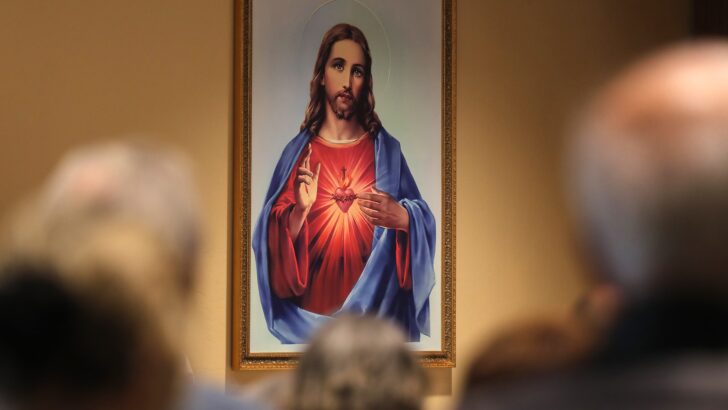
 A painting of the Sacred Heart of Jesus is seen during Palm Sunday Mass at Sacred Heart Church in Prescott, Ariz., April 13, 2025. (OSV News photo/Bob Roller)
 As Catholics, authority and revelation are obtained through reading sacred scripture, partaking in the blessed sacraments and putting our complete faith in Jesus Christ. Salvation and grace are poured out in abundance through our faith which is expressed in charity and expanded and increased through the Mass and the Eucharist. The moral teachings of the Church are set down in the beatitudes and expanded upon in the Catechism of the Church. It is my experience, that a faith fully lived out everyday bears many fruits and joys for the soul and also for the people we encounter, who feed off the gift of the Holy Spirit (indeed whether they are aware of this or not).
However, while sacramental grace and divine revelation are delights to the soul of every Catholic, we are also called to become ‘Christ like’ in every aspect of our everyday life. St Paul explains the goal of the Christian life, when he states in Romans 8.29: “For those God foreknew he also predestined to be conformed to the image of his son”.
Therefore, the Christian life is a process of becoming more like Christ in character, for when we are serious about our faith and fully surrender to the divine will of God the Father, “it is no longer I who live, but Christ who lives in me”- Galatians 2.20. The path to salvation is therefore through the grace and the power of the Holy Spirit, wherein the believers life becomes a reflection of the life of Our Lord. A beautiful summary comes from Athanasius of Alexandria, who was a seminal early Church leader and shaped the mainstream doctrine of the Trinity, when he stated that “God became man so that man might become like God”.
The question then becomes for every believer, how do I become more like Christ? I believe that this path is well set out by the saints, and in particular the Catholic mystics.
What is Catholic mysticism?
Catholic mysticism is the tradition within the Church that focuses on direct union with God through a transformation of the soul. Some of the most famous and influential mystics include Teresa of Avila, John of the Cross and indeed St Francis of Assisi. One of the most beautiful descriptions of the Soul comes from Teresa of Avila in her book The Interior Castle. This work uses the metaphor of a castle with seven rooms, each representing a deeper stage of the soul’s interior life. The journey begins with self-knowledge and purification and eventually leads to divine union. The early stage of this transformation involves prayer, mediation and moral discipline. As the soul moves closer to God, the soul enters a state of contemplation, marriage and eventually profound unity with God the Father. The book is widely regarded as a masterpiece of Catholic mysticism and a cornerstone of Carmelite spirituality.
One of the most famous mystical teachings comes from a contemporary of Teresa of Avila, St John of the Cross who describes the “Dark Night of the Soul”. This profound teaching describes a stage of deep spiritual purification that happens on the journey towards Christ. During the process a person may experience feelings of God being distant, or indeed a sense of spiritual dryness. John of the Cross states that this happens when God fully begins to purify the soul. While early in our spiritual life we feel comfort and love from God through prayer and meditation, these feeling may start to wane as our interior life develops and God becomes closer. A period of intense purification then occurs where ego, pride and attachment to worldly things are removed from a persons life. John of the Cross states that as God is infinite and beyond human understanding, to truly unite with him the soul must be purified of concepts, attachments and the ego, a so called emptying of the soul, so that Gods love can fully envelop it.
Indeed this experience reflects the experience of Christ on the cross on calvary when he cries out with deep anguish prior to his death “My God, my God, why have you forsaken me?”. This moment is clearly the deepest expression of trust and surrender to God amongst the darkness of this worldly life. Indeed, Christs love was revealed must fully on the cross, when his soul was completely transformed and his body resurrected through the greatest expression of love for his father and the ultimate act of reconciliation between man and God.
Indeed, the Dark Night of the Soul is deeply connected to the resurrection of Christ as it mirrors his life, death and rising. For the soul must die to self, before experiencing the fullness of God.
Alan Martin is a Dublin based solicitor.