

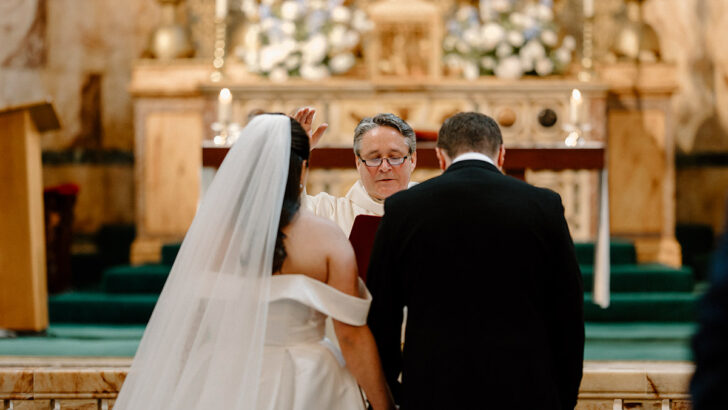
 Fr Gary Chamberland blesses a couple during their
wedding Mass at Newman University Church. Photo:
Nikayla Bautista
Fr Gary Chamberland blesses a couple during their
wedding Mass at Newman University Church. Photo:
Nikayla Bautista When Fr Gary Chamberland CSC arrived in Dublin to take up the role of rector at Newman University Church just off of St Stephen’s Green, it was not the beginning anyone could have expected.
“It was the middle of the Covid shutdown about 100 years ago,” Fr Chamberland recalled with a laugh. The Massachusetts-born priest arrived amid the pandemic, when churches across Ireland were closing their doors. Yet what could have been a period of stagnation became a moment of creativity.
The parish improvised new ways of reaching people. Fr Chamberland remembers livestreaming Mass with “a cellphone taped to a stick”.
The effort depended on the dedication of volunteers. Two young women involved in the House of Brigid programme even moved into the parish house during lockdown so they could continue helping run the church’s outreach when the two-kilometre travel restrictions made commuting impossible.
What began as improvisation grew into a broader digital ministry, allowing the church not only to broadcast Mass but to share music and liturgical resources online.
“None of that would have come about without Covid,” he says. “It gave us the time to do things we probably would never have done otherwise.”
Six years later, as Fr Chamberland prepares to leave Dublin, he looks back on a ministry of unexpected challenges but also similar moments of blessing, growth, and discovery.
One of his biggest surprises he says, has been the vitality of the Irish Church. “I’d heard so much about the death of the Irish Church, but it’s not true. It’s different. It’s limping in many ways, but it’s not dead.”
They give enough body that young Irish people who are interested in the faith have a place. Otherwise they can feel
quite alone”
Across the city, he points to signs of a “dynamism” especially from younger Catholics – from Dominican initiatives in St Saviour’s to Latin Mass communities to young adult groups in parishes such as Rathmines.
Much of this vitality, he says, comes from immigrant communities. “We’re seeing Brazilians, Spanish, Portuguese, Italians…They give enough body that young Irish people who are interested in the faith have a place. Otherwise they can feel quite alone.”
University Church
University Church itself occupies a unique position in the city. Though technically a parish, very few parishioners actually live within its boundaries. What you have instead is people traveling from across Dublin to attend Mass.
Fr Chamberland described the church as serving three overlapping communities – a traditional Sunday morning congregation made up of older folks, a growing Sunday evening Mass which attracts more young adults, and a weekday crows largely made up of workers from the surrounding offices and the like. “That’s the odd thing about this church,” he says. “Everyone who comes here chooses to come.”
Over the past six years, the evening Mass has grown steadily as young adults have begun bringing friends and forming new connections. “I actually think the young adults bring in other young adults,” he says.
Young people and old people need the social reality of church – the community, the connection with others”
A decision which he sees representing a shift from the past. “Historically when everyone is Catholic, your community is already Catholic. Now people are realising they want something, they need something, and they’re choosing it again.”
“Today young people and old people need the social reality of church – the community, the connection with others,” he says.
One small moment at University Church illustrated that shift. A young French woman who attended the Sunday evening Mass once volunteered to greet people at the door. At first, not everyone knew what to make of the gesture.
“The first time she said hello to one older man, he pulled back and walked around her,” Fr Chamberland recalls. But that welcome began to change the atmosphere. “A couple of weeks later she wasn’t there, and he came up and asked, ‘Where’s the little French girl?’”
Patrick Grant
Memories
For Fr Chamberland, the moment captured something important about how parish life grows. “It didn’t take long for that sense of being welcomed to become important,” he says.
Ministry, he says, cannot be measured purely by numbers.
“One of the things I say all the time is you have to decide what success looks like before you begin,” he says. “Numbers are actually one of the least important parts. If it’s actually about relationship – your relationship with Christ and with others – those don’t happen in groups of 35.”
Looking back, Fr Chamberland says many of the moments that stay with him most are simple ones that unfolded during the liturgy. He recalls a packed Christmas Mass when the congregation’s singing filled the church. “The music was percussive,” he says. “I could feel it hitting me.”
Other moments are more regular. Every few weeks second-class pupils from nearby Loreto schools attend Mass at the church and remain afterwards to ask questions. “They’ll ask about my vestments or the candles,” he says. “And then suddenly someone asks a question about life after death. There are some real deep thinkers in second class.”
Trust the women you work with. As is clear the world over, women actually run the Church, we’re just allowed to act like we do”
He has also been struck by the quiet faithfulness of long-time parishioners. One man who recently died had served at the altar for more than 75 years. “The day he wasn’t there, someone would always ask, ‘Is Pat okay?’” Fr Chamberland recalls. “They really care for each other.”
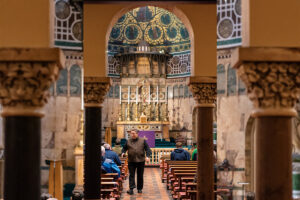
Photo: Jason Hogan.
Looking back, he hopes one of the things he leaves behind is a sense of joy. “I think part of what I brought is joy,” he says. “Church is supposed to be joyful.”
As he prepares to hand over leadership of the centre to his successor, Fr Mark Thesing CSC (who, he jokes, has replaced him once before) his advice is simple.
“Love the people,” he says. “Trust that things are going okay, and learn from them.”
He also adds another piece of advice: “Trust the women you work with. As is clear the world over, women actually run the Church, we’re just allowed to act like we do.”
And above all, he says, enjoy the ministry. “It’s actually a lot of fun.”