

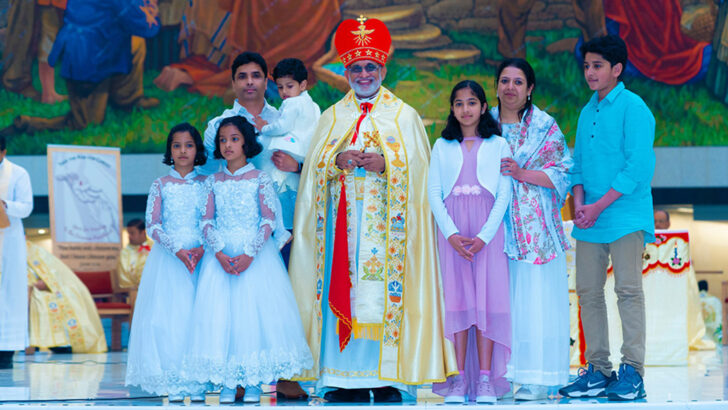
 Major Archbishop Raphael Thattil of the Syro-Malabar Church poses with children and parents during the Syro-Malabar pilgrimage to Knock in May 2024.
 The Syro-Malabar Church, an ancient apostolic community, represents a unique confluence of Christian faith and Indian culture. In the context of migration, particularly in Ireland, this Church embodies a living example of inculturation, integration, and missionary vitality. This article explores how the Syro-Malabar Church in diaspora maintains its Eastern Christian identity while engaging meaningfully with host societies. Drawing on theological, liturgical, and sociological perspectives, it argues that integration without assimilation is both possible and necessary for migrant churches to thrive as authentic witnesses in pluralistic societies.

Apostolic root in migrant soil
The Syro-Malabar Church is one of the most ancient expressions of Christianity, tracing its origins to the evangelistic mission of St Thomas the Apostle to India in the first century. From its inception, the Church has embodied an enculturated expression of the Christian faith – what Pope John Paul II would later describe as a “genuine inculturation of the Gospel”.
As a sui iuris Eastern Catholic Church in full communion with Rome, the Syro-Malabar Church is distinguished by its East Syriac liturgical tradition, apostolic spirituality, and deeply embedded Indian cultural expressions. In recent decades, migration has led to the formation of vibrant diaspora communities across the globe. In Waterford, the Syro-Malabar community reflects not only the demographic shifts of globalisation but also the missionary character of the Church in diaspora, navigating the challenges of secularisation, pluralism, and cultural transmission.
Inculturation: Hindu in culture, Christian in faith
The concept of inculturation – the process by which the Gospel takes root within a particular culture without erasing its native character has been central to the identity of the Syro-Malabar Church since its origin. As Fr Placid J. Podipara famously noted, the Church is “Hindu in culture, Christian in religion, and Oriental in worship”.
In India, Christianity took on local forms from the beginning: architectural styles, family structures, festivals, and social values were adopted into the life of the Church without compromising doctrinal orthodoxy. In diaspora contexts like Waterford, this inculturated faith must now undergo a second level of inculturation – into Western and specifically Irish secularised modernity.
These cultural forms become ‘catechetical scaffolding’, enabling the transmission of the faith in embodied, memorable ways”
This involves a double movement: preserving Indian cultural heritage while responding to the socio-religious realities of Ireland. Community practices such as celebrating traditional feasts, using Indian liturgical music, and upholding strong family structures become formative elements for young Syro-Malabar Catholics. These cultural forms become ‘catechetical scaffolding’, enabling the transmission of the faith in embodied, memorable ways.
Apostolic and Christocentric: Christian in religion
At the heart of the Syro-Malabar identity is its apostolic and Christocentric faith. The self-understanding of the community as Nasrani – meaning ‘followers of the Nazarene’ – connects them directly to the faith of St Thomas and his proclamation: “My Lord and my God” (John 20:28).
This apostolic lineage provides a theological anchor in pluralistic societies. In Ireland, where young people are increasingly influenced by secular ideologies, moral relativism, and religious indifference, a strong sense of apostolic continuity serves as a bulwark against fragmentation. The sacraments, especially the Holy Qurbana, become vital not just as rituals but as spaces of encounter with the living Christ.
Sociologically, migrant churches like the Syro-Malabar community exhibit what José Casanova calls “de-privatised religion” – a public, community-oriented religious identity that resists secular pressures toward individualism and privatisation of belief.
Mystical and oriental: The east Syria liturgy in a western context
The East Syriac Rite, with its mystical theology and deep symbolic structure, is the soul of the Syro-Malabar Church. Even when adapted linguistically or pastorally for local contexts, the core structure of the Qurbana maintains its transcendent orientation. The use of Syriac hymns, prayers, and gestures speaks to a historical continuity with the early Church and offers a corrective to rationalist or utilitarian modes of western worship.
Preserving this liturgical identity amidst the dominant Latin tradition requires pastoral sensitivity and theological clarity. Liturgical catechesis, youth involvement in altar service and choir, and bi-ritual celebrations in collaboration with the Latin Church can serve as effective bridges.
Integration without assimilation: Migrant Church as missionary Church
Migration presents both opportunities and risks. On one hand, it can enrich the host society through religious vitality, family-centred faith, and new vocations. On the other, it risks losing cultural and ecclesial distinctiveness through uncritical assimilation.
The challenge is to raise bicultural, bilingual, and spiritually mature Catholics who can navigate multiple identities”
In Waterford, the Syro-Malabar community illustrates how integration does not necessitate assimilation. While contributing actively to education, healthcare, and civic life, the community also maintains its unique spiritual and liturgical identity. This is consistent with the vision of Vatican II’s Orientalium Ecclesiarum, which urges Eastern Catholic churches to preserve their heritage as a contribution to the universal Church.
This dual fidelity – to both origin and destination requires intentional formation and leadership. The challenge is to raise bicul tural, bilingual, and spiritually mature Catholics who can navigate multiple identities without losing their spiritual centre.
Living tradition and youth formation
The concept of tradition as a living reality, guided by the Holy Spirit, is central to Catholic ecclesiology. As Pope Francis states in Evangelii Gaudium, the Church must remain open to new expressions while remaining faithful to her roots.
In diaspora communities, this takes the form of youth catechesis that integrates theology, culture, and life skills. Many second-generation youths experience a cultural dissonance between home and society. Faith formation must therefore be holistic – combining Scripture, sacraments, apologetics, and leadership training.
Programs such as youth retreats, local missions, inter-parish sports and faith events, and theological forums can help young people transition from cultural Christianity to conscious discipleship. The goal is not only to retain members but to raise missionary disciples, echoing the call of Christifideles Laici.
Identity with humility: Proud to be Nasrani
To be proud of one’s heritage is not to assert superiority, but to live with a sense of vocation and responsibility. The Syro-Malabar community in diaspora can offer the Irish Church a renewed model of intergenerational faith, family prayer life, and reverent liturgy.
As a Church of the East, the Syro-Malabar tradition serves as a reminder that Catholicism is not monolithic but polyphonic. It invites mutual enrichment rather than competition. Identity, rightly lived, becomes a gift to the broader ecclesial communion, particularly in post-Christian Europe.
Faith in the public sphere: Radiating Christ daily
As Pope Benedict XVI emphasised, “The Church does not grow by proselytism, but by attraction.” The ultimate mission of the Church is to radiate Christ – not only through liturgy and teaching but in daily life.
Syro-Malabar Catholics in diaspora are called to live as witnesses in workplaces, schools, and neighbourhoods – with joy, moral clarity, and service. Their presence in Ireland is not accidental but providential, offering a visible counter-witness to secularism and a living example of the global Catholic Church.
A Church rooted and radiant
The Syro-Malabar Church in diaspora is not merely a migrant community preserving cultural memory. It is a missionary Church, called to be rooted in Christ and radiant in mission. In Waterford and beyond, its mission is twofold: to preserve its eastern identity with integrity, and to engage western societies with the joy and depth of the Gospel.
By forming Christ-centred families, nurturing spiritually mature youth, and offering its liturgical and theological riches, the Syro-Malabar community continues the legacy of St Thomas the Apostle – proclaiming in every land and generation: My Lord and my God.
Fr Jomon Kakkanattu is a priest from the Syro Malabar Archdiocese of Changanacherry, Kerala, India working in the Diocese of Waterford and Lismore. He holds an MSc in Counselling Psychology and an MTh, and pursuing research at Maynooth University.
Migration presents both opportunities and risks. On one hand, it can enrich the host society through religious vitality, family-centred faith, and new vocations. On the other, it risks losing cultural and ecclesial distinctiveness through uncritical assimilation”
The Syro-Malabar Church in diaspora is not merely a migrant community preserving cultural memory. It is a missionary Church, called to be rooted in Christ and radiant in mission”