

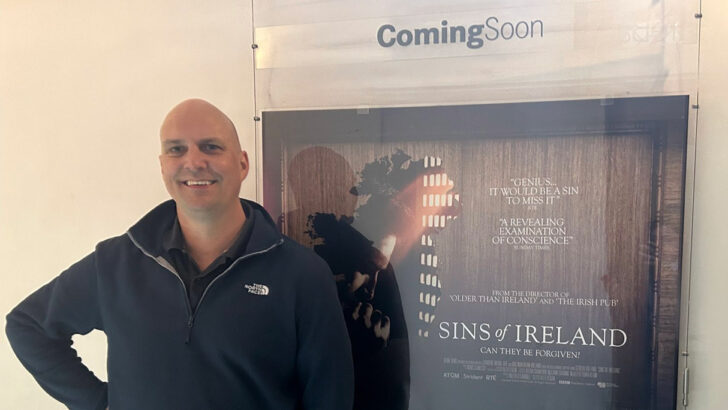
 Filmmaker of Sins of Ireland, Alex Fegan. Photo: courtesy of Atom Films.
 Released during the sombre hours of Good Friday, Sins of Ireland is the latest film from solicitor-turned-filmmaker Alex Fegan, known for documentaries like The Irish Pub and Older than Ireland. Sixteen years ago, he left the law business to pursue his passion and has never looked back—joking that “the only skill that transferred over was dealing with paperwork.”
For Mr Fegan, filmmaking has meant following the thread of Irish life wherever it leads—from the barstool to the barber’s chair to the confessional box. In Older than Ireland, he interviewed centenarians across the island who could remember the days before independence. The Irish Pub, saw him dive into local pub culture. And in Abbeyfealegood, Mr Fegan visited the Limerick town with more hairdressers and barbers per head of the population than anywhere else.
Confession
In a sense, Mr Fegan has always been drawn to confessors of one kind or another—for some, the barkeep and the barber have long filled that role.
Yet Alex Fegan will be the first to tell you that this, of all his films, is the one that changed him most. “I used to just always ask questions. Why Catholic? Why not this? Why not that? Some of the priests would say, ‘look, there are many lamps, but there’s one light.’ Then it kind of made me think about it a lot more.”
The idea for Sins of Ireland came to Mr Fegan as he watched his son get his first confession. “When [my son] went to confess to the priest, I kind of went into a daydream. And on the one hand, I was questioning what was this all about? Like, why do we still follow this cultural tradition? But on the other hand, I was really taking it all on face value. And I was kind of marvelling.
Most films I’d seen about the Catholic Church were always from the outside looking in. And I just hadn’t seen anything from the inside”
“This idea of being able to talk to God through a priest, tell him your sins, and have those sins forgiven – came across as quite an amazing thing. And I started to get kind of emotional. It was sort of like a little epiphany, almost. But I was still quite cynical as well.”
That cynical picture, he admitted, was one shaped by TV and movies and preconceived notions of ‘Catholic guilt’, as well as the very real scandals surrounding the Church.
“But there was something else,” he added. “There was a baby in the bathwater.”
The film aims to look at Ireland and the Catholic Church through the lens of the sacrament of Reconciliation. The image of the confession box looms large over the film’s priests—intentionally so, as Mr Fegan explained:
“The idea was to take a more nuanced, sort of helicopter view of this institution. Because most films I’d seen about the Catholic Church were always from the outside looking in. And I just hadn’t seen anything from the inside. Like—who are these priests? Despite all the stuff, why do they stay in it? What’s their story? And I hope the film sheds light on what they find so important about their faith.”
That’s why, he said, each interview was filmed in front of the priest’s own confession box.
“So in a way, that’s why I kind of asked all the priests to do their interviews in front of their own confession box, so that they would also be able to look inwards. And so this idea of introspection—honest introspection—is the sort of theme of the film, if you like.”
Curiosity
Along with exploring confession, Sins of Ireland gives us a look into the lives of these priests, asking what drew them to their vocation. Shot during the Covid pandemic, the film shows how priests were trying to bring the Church to people in a time of separation—an opportunity for connection.
The film also touches on the loneliness of diocesan priests—many of whom, in this age of declining vocations, lack the community and support found in religious orders. This is shown in quiet scenes of solitary meals – microwaved because there’s no time, or no one else to cook for.
Describing his own faith, Mr Fegan said: “Growing up, I went to a Catholic school, and my parents had a faith. They would have gone to Mass—still do.
“Then, like a lot of people in their 20s and 30s, I kind of moved away from it. But actually, during the process of the film, I started moving back towards the Church.”
What began as a filmmaker’s curiosity became, for Alex Fegan, a journey of reflection”
When asked if he remembered his own first confession Mr Fegan said, “My dad brought us to confession at Christmas time. And I remember talking to the priest about Santa Claus the whole time.”
So when he went to confession after the filmmaking process he said it was either his second or third time. Making that time to sit in the confession box. “I made a promise to myself at about halfway through the film to go to confession at the end of the filming. I went in and I was queuing up and I was thinking, ‘oh my God, what do I do?’
“It was actually just really profound. Because I’d talked to all these priests and got a better sense of what sin actually is. Some people say, ‘I’ve never sinned. I’ve never murdered anyone.’ But I got a better idea as to what that means and what’s the difference between guilt and neurotic guilt. I genuinely found it to be extremely profound and that definitely moved me back. I’ve been going to Mass ever since.”
What began as a filmmaker’s curiosity became, for Alex Fegan, a journey of reflection—and, at times, a quiet meditation on the small moments of grace that appear in unexpected places.
I got a better idea as to what that means and what’s the difference between guilt and neurotic guilt. I genuinely found it to be extremely profound and that definitely moved me back. I’ve been going to Mass ever since”
This idea of being able to talk to God through a priest, tell him your sins, and have those sins forgiven – came across as quite an amazing thing. And I started to get kind of emotional”