

 Martina Purdy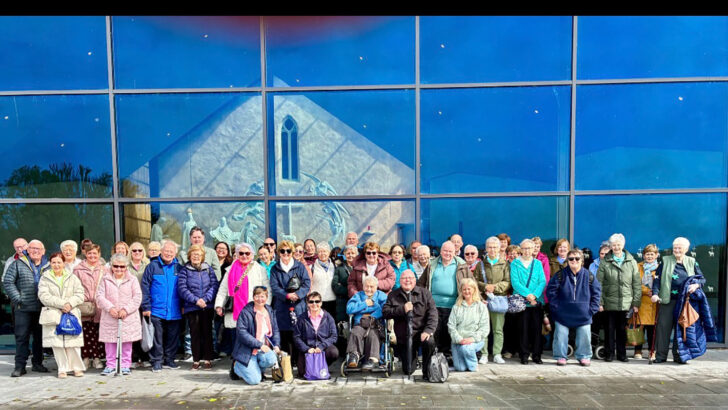
It was 1949 when Michael McErlain first set out for Knock. In those days, the journey from Belfast could take up to eleven hours involving a train to Dublin, a transfer at Claremorris, followed by a bone-shaker bus to the pilgrimage site. “I don’t remember much about it,” said Michael, “Other than the train – you got a cooked breakfast and I was too young to cut the sausage and bacon. ‘Just lift it in your hand, son’ I was told.”
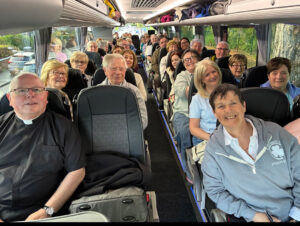
He smiles at the memory which surfaced when Michael joined almost 50 others on our parish pilgrimage last week. We all packed into a luxury modern bus and hit the road for Co. Mayo, stopping for tea and scones, and arriving by lunchtime. This was our third pilgrimage in three years at St Michael’s Parish. Trips to Knock, I was told, were more frequent in the nineties when our parish bus once stopped at Knock airport to collect a VIP visitor, English gardener, author and broadcaster Alan Titchmarsh.
Community
This time, the only thing we collected was a boxful of prayer petitions from those who were unable to travel. When Elaine Kelly and I first offered the pilgrimage in 2024 as part of our parish work, it took around six weeks to fill the bus with 30 pilgrims. This year, we were completely booked out within 48 hours – with regulars and newcomers joining our spiritual director and parish priest, Fr Ciaran Feeney. “We could have filled our 50-seater twice over,” said one parish worker. “People were still phoning the day before we left.”
When we arrived, Knock Main Street seemed unusually quiet. “Knock hasn’t recovered from the lockdown,” remarked one pilgrim. But soon a busload of Chinese pilgrims drove up to our hotel, some from Hong Kong and some from Canada. They were swiftly followed by a busload of English visitors. There were also classes of young people on day trips to pray for exams – and even a procession on the Feast of Our Lady of Fatima, when around a hundred East Timorese pilgrims sang and prayed. “They have come a long way,” I remarked. “No,” I was informed. “They are from Dungannon, in Co. Tyrone – they come regularly.”
I think that’s what Knock is all about, giving people respite from the crazy things in life, to just come and have peace in your heart”
Although they prayed in their own language, the rhythm of the rosary was the same.
Kathleen Boyle was on her first trip to Knock in ten years and is more often found at Medjugorje. “There is a great peace here,” she told me. “A real serenity. We Irish go to Medjugorje, but we have it here in Ireland.”
Another pilgrim, Theresa Maguire, agreed. “Lourdes is beautiful and I get a lot out of it but, to be honest with you, Knock has something special – and when I think of the history that is here – that it’s also a Eucharistic shrine – it’s absolutely amazing. Mary, the Mother of God, came here to comfort the Irish people, and I think that’s what Knock is all about, giving people respite from the crazy things in life, to just come and have peace in your heart.”
As for faith in Ireland, the pilgrims I spoke to have noticed more people in their twenties and thirties coming to Mass and practising their faith. “Absolutely,” said Theresa Maguire.
Hugh McConville, aged 43, was among the younger ones on our bus. He said he can certainly see a change in others and how he approaches his own faith, going deeper. “Ten or fifteen years ago, there was a lot of doom and gloom around the church.”
His wife, Marie, who was born and raised in the Philippines, however, lamented that so few children attend Mass these days “It’s a big problem,” she said.
Marie, a nurse, was particularly interested in learning about the cures at Knock. “Everybody knows about Lourdes and Fatima, but not everybody knows about Knock.”
Division
Asked about the state of the country, Marie said she still sees division – especially around faith.
Others focused on divisions between Catholics in America. “There’s too much politics around,” said Teresa Maguire, who suggested that Catholics might focus more on the sacraments and living a life of faith.
A few others described the church as “under pressure”.
“People are so far removed, and the church can’t do right for doing wrong,” said Kathleen Boyle. “I think we have wonderful priests, wonderful lay people and if only people would just give them a chance and come in ‘to taste and see that the Lord is good’. I was never away from my faith, but when I really started coming back, I said, ‘Oh my goodness, they are so happy. I want some of what they have.”
She is also impressed with the number of people in their twenties and thirties who are turning to God. ‘Little by little, Ireland is coming back to the faith’”
Veronica ‘Bunny’ McGreevy, who joined us from a parish in Newcastle, Co. Down, suggested that the church had weathered the worst of the abuse scandal and how it was handled. “I admire the generation of priests that we have now, many of them, in their seventies or eighties, who have helped us weather the storm. Obviously, we are going to have difficulties with a shortage of priests until that gap is bridged.”
At age 65, she insisted that older people still have an important role to play in keeping the faith alive. She is also impressed with the number of people in their twenties and thirties who are turning to God. “Little by little, Ireland is coming back to the faith.”
She cited “great movements” around the rosary, especially the Rosary Rally in Knock on June 6 – and other devotions, particularly to St Carlo Acutis and the Divine Mercy.
She shares concerns about the state of the country, citing the curriculum on sex education for children and also abortion law “manufactured by money from outside the country.”
Hope
Laurence Kennedy of Loughshore parish in Belfast, came along on our pilgrimage with his wife Geraldine. “Faith means a lot,” he said. “More and more as I get older.” He was among the pilgrims who expressed great hope for the future despite the lack of vocations to the priesthood and the likelihood of church closures. “I’m always hopeful for the future – that God will come though and work some sort of miracle to bring us out of what seems a bit bleak.”
He was impressed with Knock as it marks 50 years since the Basilica was built and almost 150 years since the apparition. “It’s very relaxing. There is an atmosphere here. If we could bottle it and take it home, it would be very good.”
**
My parish recently reintroduced children’s adoration to prepare the little ones for their First Communion. We started in Lent. Our last session was held in St John the Baptist school as the church was not available last Friday. Over the weeks, the children from this school and the integrated school, Cranmore, had impressed my colleague Elaine Kelly and I with their enthusiasm for adoration – quickly learning ‘O Sacrament Most Holy’ and joyfully singing, “Come Let us Adore Him.” But we were really blown away last Friday when, after the Blessed Sacrament was reposed, the boys and girls, full of excitement that they would receive Jesus for the first time the following day, spontaneously clapped and chanted, “Communion, communion, communion…!”
**
As we celebrate Pentecost Sunday this weekend, it is good to remember that the novena prayer is an echo of the nine days between Ascension and Pentecost when the Apostles and Our Blessed Mother prayed together. The novena is not – as some people suggest ‘a made-up Catholic thing’ – but yet another Catholic tradition rooted in scripture.