

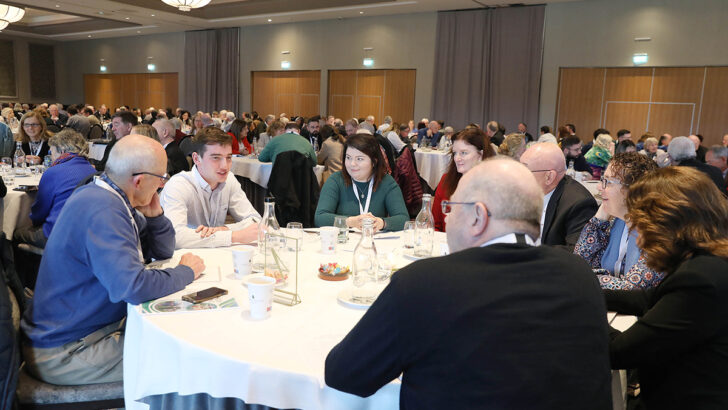
 Delegates take part in ‘Conversation in the Spirit’ during the pre-synodal assembly in Kilkenny in October, preparing for the 2026 National Assembly.
 The Irish Synodal Pathway has entered a significant new phase as seven newly established national ‘Working Groups’, comprising 64 lay, religious and clerical members, have begun applying years of prayerful, listening and communal discernment into practical proposals for the National Synodal Assembly on October 17 next at City North Hotel in Co. Meath.
After five years of consultation across parishes, dioceses, schools, ecclesial movements and ministries, the synodal question that was posed at the outset of this process, namely, ‘What does God want from the Church in Ireland at this time?’, has led to identifying seven key priority areas for Church renewal: Belonging; Co-responsibility and Lay Ministry; Faith Formation and Catechesis; Family; Healing; Women; and Young People.
Priorities
These seven priorities were identified through the Irish Synodal Pathway’s nationwide listening process that coincided with the Universal Synod (opened by Pope Francis in October 2021) and set out in the Irish Pathway’s 2025 document Baptised and Sent. They reflect many of the hopes, concerns and aspirations expressed by the People of God throughout Ireland.
To carry this discernment, each ‘Working Group’ will focus on its specific priority, and will do so by drawing on the expertise of its membership which includes parish and diocesan ministry, pastoral work, Catholic education and school leadership, theology and academic research, catechesis and faith formation, youth ministry, family ministry, healthcare chaplaincy and hospice care, safeguarding and child protection, psychology and counselling, canon law, retreat and spirituality work, social justice and advocacy, ministry with migrants, refugees and other marginalised communities, ecological initiatives inspired by Laudato Si’, communications, organisational leadership, and service on the Councils and Agencies of the Irish Catholic Bishops’ Conference.
Each ‘Working Group’ includes a member of the National Synodal Team, a bishop, a person with national Church responsibility in the relevant area, and others with lived experience, theological insight and pastoral expertise.
Rather than attempting to address every aspect of Church life, each group has been asked to discern a small number of realistic and actionable proposals”
During the week of February 24, members were invited to take up this responsibility. They gathered online for an introductory meeting on March 10, beginning with the Synod Prayer and closing with a commissioning prayer. At that meeting, the members of each group were reminded that they had been nominated and chosen because of their experience and competence, and they were encouraged to trust the gifts and wisdom that they are bringing to this shared work of discernment.
The task facing the members is both pastoral and practical. Rather than attempting to address every aspect of Church life, each group has been asked to discern a small number of realistic and actionable proposals that can be implemented at parish, diocesan and national levels.
The work of the seven groups is not just rooted in the insights gathered during the Irish Synodal Pathway, but it is also informed by its documents, including the National Synthesis (2022), Towards October 2024 (2024), Baptised and Sent (2025) and the documents of the Universal Synod, For a Synodal Church: Communion, Participation, Mission Final Document of the Universal Synod (2024) and Pathways for the Implementation Phase of the Synod (2025). For further details, see Synod.ie.
The current activity of each ‘Working Group’ has been informed by a structured submission template that they received on April 24 in order to support the discernment process. This template invites groups to explain how they worked together, what they heard, why they are proposing particular recommendations and the broader pastoral and missionary vision for the Church in Ireland that underpins their work.
Each group will then submit up to seven proposals, outlining the rationale, the intended impact and the possible implementation of each recommendation. This is to ensure that the proposals do not remain aspirational but are grounded in a realistic assessment of the resources and capacity available at parish, diocesan and national levels so that they can be implemented in practice.
Submissions
Submissions are due to the National Synodal Team by May 31. Following review and feedback during June and July, it is hoped that the proposals will then shape a working document for the National Synodal Assembly in October. At the Assembly, each group’s rationale will be presented before its proposals are considered by delegates from across the Church in Ireland.
Further details about this stage of the process, including the names of the ‘Working Group’ members, have been published this week on the Irish Synodal Pathway website. Everyone has been invited to keep the members of the groups in prayer and to respect the integrity of the discernment process. In this regard, all queries – from the public and the media – should only be directed to info@catholicbishops.ie.
As stated, this stage marks an important moment in the Irish Synodal Pathway and in the continuing discernment of how the Church in Ireland is being called to renew its life and mission. The Church has, and is, listening attentively to the voices of its people. Now, through these ‘Working Groups’, this listening is being translated into concrete proposals. Our hope is that this prayerful work of discernment will help shape the future of the Church in Ireland and support its renewal for years to come.
Julieann Moran is the General Secretary of the Irish Synodal Pathway.