

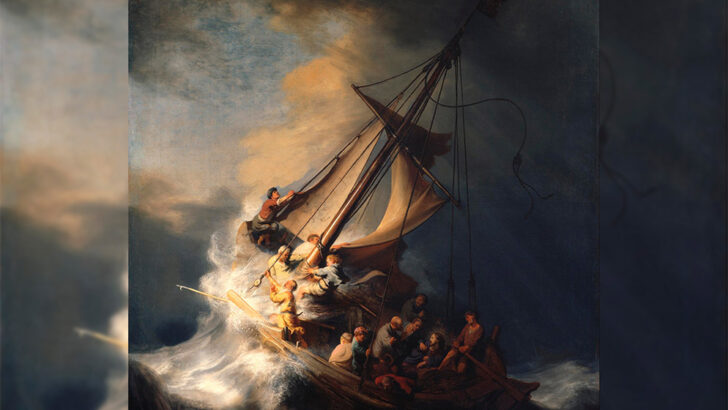
 Rembrandt’s Christ in the Storm on the Sea of Galilee. Photo: Wikimedia Commons/Public domain.
 Gospel realism does not try to sand away the hard edges of life says Fr Chris Hayden
On May 10, 1940, Winston Churchill became Prime Minister of Britain. Three days later he told his cabinet that he had “nothing to offer but blood, toil, tears and sweat.” Later the same day, he repeated those words to the House of Commons, and his speech was broadcasted to the nation.
What happened as a result of Churchill’s sombre words? Did people become depressed and disheartened? Quite the opposite! The country was galvanised, profoundly heartened; people rallied at the prospect of a campaign, at home and abroad, that held out the hope of victory. Not easy victory, or swift victory, but eventual victory.
As an Irishman, I have no desire to canonise Winston Churchill, yet that moment in British history has often reminded me of a much earlier moment, a moment in Biblical history, when Paul and Barnabas addressed believers in a part of what today is Turkey (you’ll find the incident in chapter 14 of the Acts of the Apostles). The concern of those evangelists was to strengthen and encourage the disciples, and the content of their speech is very instructive indeed. But first, let’s be clear on what Paul and Barnabas did not say. They did not say, “You’ll be grand,” or “Things are fine.” They did not take the route of easy affirmation or bland reassurance. Deep encouragement calls for something more than comfort or sympathy, and those two evangelists anticipated the Churchillian approach. “It is through many tribulations,” they said, “that we must enter the kingdom of God.”
No sugar-coating there; no quick fix; no broad and level path; not these, but the narrow gate and the hard way Jesus speaks about in the Gospel. Gospel realism is just that: realism. It does not try to sand away the hard edges of life. Rather, it urges us – while also enabling us – to take up our cross and to help others with theirs, to find resilience beneath our vulnerability.
Hardship
That we must experience hardships is a given, a part of the human situation; it is not so much a faith statement, as a simple observation. But how we respond to hardships and challenges is also, for Christians at any rate, a matter of faith. The culture we inhabit today is not that of Churchill’s Britain, a culture that encouraged people to dig deep and find strength and resolve. There is, of course, more to human strength than the fabled – and occasionally caricatured – British stiff upper lip, but stoicism in the face of suffering can be a noble quality, and a more productive one than the vulnerability in which our culture is more likely to coach us.
“Lift your drooping hands and strengthen your weak knees,” says the Letter to the Hebrews, quoting the Prophet Isaiah. If contemporary culture has a default message, it is probably closer to, “Respect your vulnerability and assert your need for validation.” To point to this contrast does not mean adopting an uncaring attitude to those who are vulnerable, suffering or fragile. Rather, it is to point out that resilience is at least as significant a human characteristic as vulnerability, while being mindful that our faith both asks resilience of us, and, by giving us resources of wisdom and grace, offers resilience to us.
We may see people turning from faith to despair, as they angrily wonder where God is in all that is happening”
Matters of the spirit are generally simple in principle, even if not always easy in practice. The promise of our faith in a time of anxiety is simplicity itself: we can turn to God with our fears and our worries; we can share the burden with him; we can, in the words of St Peter’s First Letter, “cast all our anxieties onto him.” This will not always bring a felt comfort, yet hope runs deeper than feelings. By maintaining space for God, who is Being Himself, we can know something of the quiet hope and consolation experienced by the great Jewish Carmelite martyr, Edith Stein: “In the knowledge that Being holds me, I rest secure.”
We live in tumultuous times. We may see far greater tumult. We may see people turning from faith to despair, as they angrily wonder where God is in all that is happening. But if, because life is hard and perplexing, I turn from faith, then I gain nothing whatever. Granted, I may ‘solve’ the ‘mystery’ of suffering, but only at the cost of denying that it can ever have any lasting meaning, which is not a great exchange. If, on the other hand, in a bewildered and anxious world, I cling to the God and Father of Jesus Christ, trying, in all my brokenness, to live a life of faith, hope and love, a life guided by the virtues of prudence, justice, fortitude and temperance… if I retain this vision, then I gain a very great deal indeed.
There will always be those who regard this as a matter of whistling in the dark. So be it; but let outlooks and philosophies be judged by their fruits. Better to be “strong in the Lord and in the strength of his might” (Ephesians 6:10), than to be weak and rudderless in a world that seems determined to believe the Lord is incapable, absent, or dead.
This is the fourth instalment in Fr Chris Hayden’s series,‘Faith in a time of anxiety’.