

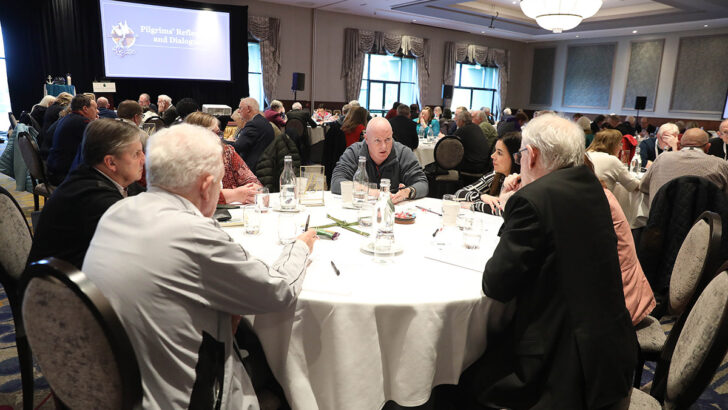
 Pre-Synodal Assembly. Photo: John McElroy.
 ‘Better to light a candle than curse the darkness’
Dear Editor, Fr Donal Dorr’s encouraging letter of June 18 urging the forthcoming synodal gathering to look outwards as well as inwards prompts the thought: what a wonderful life-enhancing place the Irish Church could be if we were all to fully embrace synodality in the manner first envisaged by Pope Francis and now followed by Pope Leo.
How might this look? Take just two matters raised by Fr Dorr: peacemaking and care for the Earth. The call for Irish Catholics to be peacemakers might initially find expression in parishes setting aside 30 minutes each week to pray for world peace. This could take place at weekends or perhaps before mass on Sunday. Regarding care for the Earth we need look no further than Bishop Monahan’s example in Clare which has seen church grounds and graveyards becoming havens of biodiversity. While the Irish Bishops Conference agreed in 2023 that parishes would return 30% of church grounds to nature this proposal needs an engaged and empowered laity to drive it forward. A synodal Church would also make available at least some of its underused property portfolio to provide homes for some married couples who need affordable accommodation. While this would only be a drop in the ocean in light of present demand for housing as the old Chinese proverb says: better to light a candle than curse the darkness.
Despite the significant challenges facing the synodal gathering in October that have been identified in recent issues of The Irish Catholic, the Irish Bishops still have an opportunity to fully embrace synodality. This will however require them to move towards a Church where they share governance and decision making in a meaningful way with other religious and the laity.
Yours etc,
Garrett Sheehan
Clonskeagh, Dublin 14
===
Requests for summer dues require more context
Dear Editor, The current request for summer dues “to support the salaries of all priests” strikes me as a tad presumptuous. It recalls for me two phrases, one from the distant past, the other more current. Firstly, in the little green catechism I learned by rote in school outlined, in lesson 20, the precepts of the Church, the fifth one stating that we are commanded “to contribute to the support of our pastors”. The second, more cynical phrase is that some believe that we are being commanded to “pay, pray and obey”.
A blanket request for dues to support all priests surely requires some background information. Firstly, what are the current salaries paid to serving priests? In addition to their salaries, what is the average amount of stole fees paid? What other perks do serving priests enjoy? Are priests financially better or worse off than their parishioners? For example, why would a person on the basic old age pension contribute to priests who have an income greater than their own? Granted, people may feel obliged to contribute to priests who deliver meaningful pastoral care. But why contribute where there is no pastoral care?
However, I am fully in agreement in contributing to the care of elderly, retired priests who have given a lifetime of pastoral care and who now live in care or nursing homes on a limited income, if any.
Yours etc,
Tony Corcoran
Rathfarnham, Dublin 14
===
Further appeals needed for lay involvement
Dear Editor, The Irish Catholic feature on Bishop Leahy’s assessment of declining levels of laity participation in his diocesan parishes (June 18) was probably the most important front-page feature for some time. It mirrors Joseph Ratzinger’s prediction in 1969 which includes “She (The Church) will become small and will have to start afresh more or less from the beginning.” Perhaps of interest too is Georges Bernanos’s fictional French priest. On page 1 of Diary of a Country Priest he comments, “My parish is bored stiff; no other word for it…We see them eaten up by boredom, and we can’t do anything about it.”
Despite his prescience Ratzinger knew that something could be done about it. Today’s French Church is characterised by many pockets of renewal, parochial and otherwise.
Along with inviting people to join Him, the Good Shepherd linked His authority to his ministry throughout the Gospels. Jesus “receives” the person who subsequently “receives” the Father’s gift which enables service to the Church – the only authorised presence of Christ’s authority in the world. The mutual reception of each other by the person and God sources significant motivation for participation in and perseverance with lay involvement in the Church.
It is a significant “Martha” ministry ready for immediate pursuit; a service to Christ in the church tabernacle offering witness to the Catholic faith when such is unfashionable; a personal effort offerable at every Mass. The decline cited by Bishop Leahy is part of a general falloff in faith, whose remedy primarily requires those “sent” (priests and bishops) to teach the Catholic faith in its entirety. Bishop Leahy’s report hopefully presages further appeals and exhortations to a wider range of laity to help maintain and improve the physical and operational infrastructure necessary for priests to pursue their ministry.
Yours etc,
Neil Bray
Cappamore, Co. Limerick
===
Treating sacred relics as sacred should be a priority
Dear Editor, ‘Rare gold ciboriums found in Newry convent’ was an Irish Catholic news story (June 10) that caught my attention especially when I read that the ciboria were being sent for auction.
Like most fellow Catholics, as a young person, I was taught to respect the utter sacredness of chalices, ciboria and monstrances. Surely these sacred vessels that were home to Jesus in the Eucharist should not be sold off to the highest bidder and for whatever secular purpose a new owner might have for them.
I am perplexed at how little some Irish dioceses and religious seem to value our most sacred objects. And so a plea: when churches, convents and schools are being closed or amalgamated that diocesan authorities return to old ways and ensure that what were once sacred remains are cared for or are disposed of to “mission countries” where these objects are much appreciated and will continue their sacred function.
Yours etc,
Alan Whelan
Catholic Secondary School Parents Association
===
The risk in using ‘inclusive’ language
Dear Editor, A recent crime case was emblazoned across TV screens that should make us think again about the concept of “equality”; when social workers and courts can decide who is to “parent” a child. Or, to use more “inclusive” language, “care” for a child.
This case occurred in England but it could have happened here in Ireland.
In Leaving Cert exams recently students were faced with a question about social care and the words “mother”, “father” and “parents” were excluded; instead the word “carer” was used.
What happened to that poor little baby (referred to the legal terminology as “under 13” or “under 16” years old – but he was a few months old, and dead at a year and one month old) could not have happened without the ideology that is called “equality” and the State Agencies who have embraced and pushed this agenda.
The story was broadcast widely on news channels a few days ago but none of the newspapers featured the story, and it’d take great bravery for any of the hacks that do those bombastic ‘opinion pieces’ to raise the issue or discuss in any meaningful way the heart of the matter; watch while the amnesia sets in—like it never happened and couldn’t happen, therefore it didn’t happen—or as the great champion of truth and justice Lord Denning described it: “an appalling vista”.
There won’t be marches in the streets or nationwide candle lit vigils or books of condolences for that poor baby, no howls of outrage from the multitudes and the Great Defenders of Liberty etc. Or for the many babies like him, poached by social workers with an agenda from the parents born into poverty whose voices will never be heard and who will mourn their loss with scant regard.
Yours etc,
Maria Ni Mhurchu
Broadstone, Dublin 7
===
Politicians out of touch with the will of electorate when it comes to abortion
Dear Editor, A major rupture between our political leaders and the electorate has been revealed by last week’s Dáil vote to advance the Sinn Féin Bill to eliminate the three-day wait before proceeding to procure a miscarriage.
This three-day reflection time was included in the supporting legislation accompanying the 2018 Referendum to reassure us, the electorate, that we were not being asked to vote for “abortion-on-demand”.
For the voter, it acknowledges the gravity of what is at issue; a life-and-death decision, with life-altering implications.
It provides a 72-hour pause for a woman to overcome the initial fears, shock, and confusion, so as to think more clearly, explore options and consequences, and thereby avoid making an impulsive decision which may lead to years of regret, relationship breakdown, self-harming behaviours, and emotional numbness.
It also represents a safeguard for women from being bounced into a procedure they are not quite ready for, due to the momentum inherent in a clinical setting, to get on with things.
Has it achieved this end? The O’Shea abortion legislation review report (2023), failed to consult with any of the 10,000 women who went for their initial appointment but did not go any further. It would appear that those sponsoring this Bill have not done so either. All can agree that dozens, perhaps hundreds of babies, and school going children, are alive today because of it. It’s working as intended. There are similar waiting periods in Germany, Italy, Belgium, and elsewhere.
Why are all our main party leaders against it, as happened in the family and carers Referendums when those same party leaders were found to be so out of touch with the will of the electorate?
How can we ever take political assurances – even those set out in accompanying legislation – seriously in advance of any future referendum?
Yours etc,
Gearóid Duffy
Lee Road, Co. Cork