

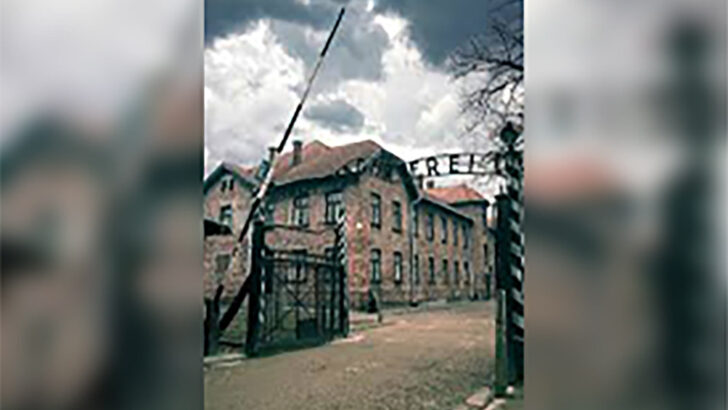
I have just returned from the general chapter of the Dominican Order in Krakow, Poland. One Sunday during the proceedings we visited the extermination camps of Auschwitz and Birkenau. These camps situated in close proximity to each other were the largest and most infamous Nazi extermination camps during the Holocaust. Located in occupied Poland, Auschwitz was established in 1940 primarily as a concentration camp for political prisoners. By 1942, it had expanded to include Birkenau (Auschwitz II), which functioned as a major extermination centre as part of the Nazis’ “Final Solution” to eliminate European Jews.

Auschwitz-Birkenau became the site of mass murder on an industrial scale. Over 1.1 million people, most of them Jews, were murdered there between 1942 and 1945. Victims were transported in overcrowded trains, often after being deceived into believing they were being relocated. Upon arrival, most were immediately selected for death and sent to gas chambers disguised as showers. Their bodies were later burned in crematoria.
Others were subjected to forced labour, starvation, disease, and brutal medical experiments. The camp was liberated in January 1945, 80 years ago. As we walked through the camps we did so in silence, words were useless in the face of such evil, for there is no other word for these places. Today, Auschwitz-Birkenau stands as a memorial, reminding the world of the horrors of genocide and the importance of remembering history to prevent such atrocities from happening again. But do we ever learn!
In a strange way I found myself gaining some comfort in the knowledge that this was 80 years ago, years before I was born. But such comfort did not last. One evening during the chapter a Dominican bishop in the Ukraine led us in a prayer vigil for peace. A group of eight people who are suffering in the midst of war today came to the chapter and shared their horrific experiences. I know they were eight of these brave people, six women, an artist and a Dominican priest, for each shared their stories in the context of one of the beatitudes.
Now there is no place to hide and seek passing relief. I could not say “that was 80 years ago”. This is happening now. The border with Ukraine was just 90 miles from Krakow, you can drive to the border in less than 4 hours. These people sharing their stories with us were not in black and white photographs but standing in the same room where I could look into their eyes and see the pain. Their bombed-out homes are not museums. Their dead sons and husbands were not statics.
But war is not just in Europe and Ukraine. As the proceedings of the chapter went forward more and more provincials told us of how they are trying to support the brethren who continue the preaching of the Gospel in many places of war and violence, religious persecution, tribal tensions and among drug cartels. Not all these theatres of war and violence make it unto our TV screens and news reporting. Most of them are never mentioned and will never be mentioned by the networks.
As I returned to Ireland, I thanked God for our country and how lucky we are to be living in such a peaceful place. But when I returned, I read of the violent attacks on immigrants not five miles from my office. We must never take such peace for granted. We must never accept violence as a way of life or as a means of settling our disputes, imaginary or real. We must have the courage to live in the context of the beatitudes, “Blessed are the peace makers, they are the children of God”.
Icon of Our Lady
This icon was pained by the late Sr Paula Mary George OP of the Dominican contemplative monastery in Drogheda. Sr Paula Mary was deeply moved by the images of mothers and children queuing with luggage to board trains and buses when Ukraine was invaded in 2022. She said such scenes reminded her of her own childhood in England during World War II when she and her mother needed to move frequently while her father served with the RAF. She prayed fervently for the people of Ukraine and her art was an integral part of her prayer. The icon is now in the Dominican church in Kiev.