

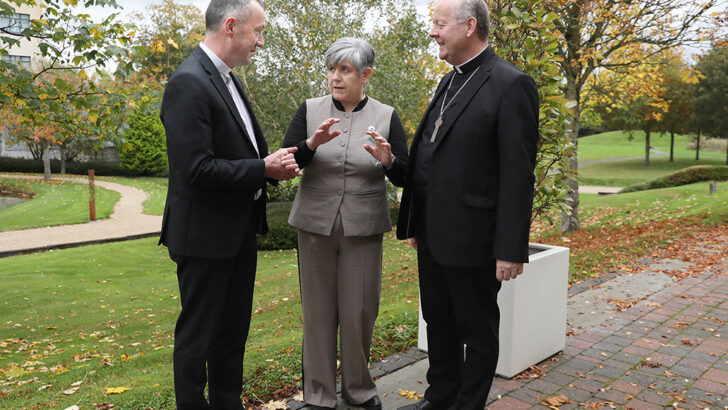
 Fr Declan Hurley, Chairperson of the National Synodal Team, Julieann Moran, General Secretary for the Irish Synodal Pathway and Archbishop Eamon Martin, Archbishop of Armagh, Primate of All Ireland chatting during a break at the Pre-Synodal Assembly of the Irish Synodal Pathway which was held in Kilkenny on Saturday. Photo: John McElroy.
 The Pre-Synodal Assembly in Kilkenny was, in every sense, a grace-filled and hopeful gathering. Over 230 delegates from all four corners of Ireland came together in what was truly a moment of genuine ecclesial encounter. From the first registration queue to the final blessing, the weekend carried an unmistakable buzz; an energy born of gratitude for how far the synodal journey has already come, and a quiet anticipation of what still lies ahead.

The organisation was seamless. The venue was welcoming, spacious, and beautifully prepared. It offered the right balance between formality and friendliness. Hospitality was warm and typically Irish; tea breaks became moments of communion, not just refreshment. Conversations spilled into corridors, coffee docks and car parks as participants compared notes, shared experiences, and found resonances in one another’s stories. It felt like the Catholic Church at her best: open, listening, and alive.
Grateful
Afterwards, I was grateful to read the thoughtful reflections on the Assembly by Fr Gerry O’Hanlon SJ. His honesty about his sense of “deflation” that followed the day will resonate with some who were present.
I, too, left feeling both grateful and unsettled. Grateful for the grace and goodwill that permeated the whole gathering, but acutely aware that something deeper was stirring beneath the surface. I am not certain that there was a collective or widespread sense of deflation. On the day, and in the days following, I and many other members of the National Synodal Team received messages of gratitude and appreciation for all that was done and all that is yet to come.
Perhaps we are reading the same experience through different lenses: Gerry through the lens of desolation as teacher, and I through the lens of quiet gestation. Perhaps what we experienced in Kilkenny was not a failure of energy or excitement, but a moment of transition; the kind of quiet turning point that often precedes genuine renewal.
The National Team was no longer asking, ‘have we heard you correctly?’ but rather, ‘have we heard God?’”
Of course, the fire and elation of Athlone in 2022 made that assembly different. Athlone was a very different event, coming at the end of a very broad consultation in which people had expressed themselves freely and articulated hopes and desires in a manner that had never been afforded them previously. Gathering in Athlone, the then National Steering Committee asked, “have we heard you correctly?” Naturally, everyone heard themselves in the feedback and there was a shared joy in that. The process towards Kilkenny, however, was significantly different. The National Team was no longer asking, “have we heard you correctly?” but rather, “have we heard God?” Pope Francis constantly referenced this key element of synodality, namely the necessity to move from listening to one another to discerning what God is asking of us.
The Irish Synodal Pathway continues to hold before us the question first posed by the Bishops in 2021: “What does God want of the Church in Ireland at this time?” It is hard to imagine that the answer to such a question could remain at the level of structures or functions alone.
Scripture
In Scripture, God’s call is always to a change of heart, to conversion. I heard that word spoken so often at the Jubilee of Synodal Teams in Rome last weekend, and it captures what is unfolding among us. The focus on the primacy of baptism, and the seven priorities that flow from it, marks an important moment in that process of conversion. It invites a renewal that reaches not only our ways of organising, but also our ways of believing and belonging. Ultimately, it calls us to hearts renewed by the Holy Spirit, hearts alive with a desire for mission. While setting out seven priorities might, on the one hand, appear as a reduction, they hold something spacious. It is possible for everyone to see themselves and their longings and hopes in them. The first of these – belonging – echoes the desire Pope Leo XIV spoke of at Mass last Sunday, during the Jubilee, when he said, “A Church that does not judge as the Pharisee judges the tax collector, but becomes a welcoming place for all.” At this point on our synodal journey in Ireland, it is possible for us all to stay together.
One of the great consolations in Kilkenny was the visible presence of young people. Diocesan youth who had been part of the Jubilee celebrations brought vitality and faith that lifted the room. The music ministries, animated by younger faces, gave the liturgies vibrancy. Even the presence of St Brigid’s Crosses on
each table, crafted by local 5th and 6th class children, were a subtle sign reminding us that renewal will be multigenerational or not at all. The Holy Spirit’s movement, it seems, is not confined to any one age group.
A few participants struggled to see how the seven priorities could be implemented, revealing a need to nurture imagination as well as structures”
Of course some challenges surfaced. As the scale of the next phase became clear with seven national priorities, seven working groups, and a call for visible progress within a year, apprehension surfaced. This is natural. When paradigms shift, familiar frameworks loosen and people get nervous. A few participants struggled to see how the seven priorities could be implemented, revealing a need to nurture imagination as well as structures. Others voiced concern about the lack of visible ethnic diversity, a reminder that inclusion must begin locally if it is to be authentic nationally. Some uncertainty also emerged about where the priorities originated. Some worried that the process was pre-determined, that outcomes were already decided. These are honest questions, born of a Church still healing from past wounds. Communication and formation will be vital in keeping trust in the process alive. But even resistance can be a grace. Pain signals life; resistance signals movement. If there were no discomfort, it would mean nothing was shifting. The Holy Spirit rarely works through comfort alone. What matters now is that we continue to walk together with patience, courage, and the humility to let the process mature.
Concerns
As with any large gathering, there was always going to be differing emphases and concerns. Some contributions made from the floor naturally reflected strong personal convictions or particular concerns, and at times these sat alongside the quieter, more reflective conversations happening at the tables. But that, too, is part of synodality: learning to hear every voice, to discern what is of the Holy Spirit and what is simply preference or fear. The real work of listening and discernment happened around those tables, where lay women and men, priests, deacons, religious, and bishops met eye-to-eye, not microphone to microphone.
Gerry speaks very movingly of the need to “re-ignite the flames.” I would say that perhaps the fire is still there, just burning in a quieter, steadier way; a refining flame that accompanies growth.
Renewal is not always exuberant; sometimes it is the slow work of the Holy Spirit, deepening roots before new shoots appear. If the National Synodal Assembly planned for October 2026 is to be a moment of these new shoots, a true ecclesial re-birth of the Church in Ireland, then Kilkenny certainly felt like practice contractions telling us that the body is preparing for real labour. The assembly in Kilkenny was never meant to be the birth itself, but a rehearsal, a time of stretching and testing our capacity to listen, discern, and trust the Holy Spirit’s rhythm.
The question of focus was rightly raised by Gerry. His suggestion that the next phase might narrow its lens to one or two priorities, especially co-responsibility and the place of women in the Church, is a perspective to consider. However, as I have said already, all seven priorities are interwoven, and flow from a single source – baptism – the wellspring from which every synodal impulse flows. Renewal will come not from managing one issue at a time but from each diocese or community embracing one or two areas they feel called to explore, so that by next year the Church in Ireland can offer genuine learning and lived experience across all seven priorities.
What happened in Kilkenny was not a finished product, but neither was it a cul-de-sac. It was a moment, a living rehearsal, a glimpse of what it means to be a people walking together: joyful, hesitant, courageous, and still learning how to listen and discern God’s will. If Kilkenny felt like a moment of contraction, it may also have been a sign of life, stretching us for birth, preparing us for something real. Our task now is to stay with that movement; to walk with courage, patience, and trust that what is being born among us is not our project but God’s. That, surely, is the most hopeful sign of all.
Julieann Moran is General Secretary of the Irish Synodal Pathway. For more information please see www.synod.ie