

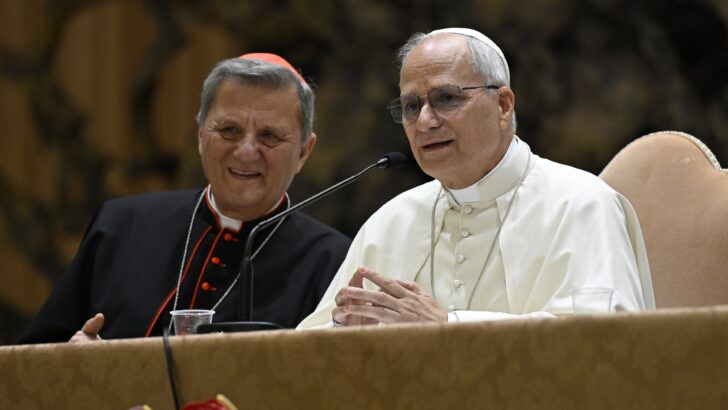
 Pope Leo XIV, with Cardinal Mario Grech, secretary-general of the Synod of Bishops, listens to and answers questions from participants in the Jubilee of Synodal Teams and Participatory Bodies in the Vatican audience hall Oct. 24, 2025. (CNS photo/Vatican Media)
 Parish priests — not bishops, not the laity — are the critical cohort who will determine whether the synodal vision of Pope Francis takes root in the life of the Church. That was the firm assessment of Prof. Michael W. Higgins, the veteran Canadian Vatican journalist and academic, speaking at All Hallows College, Dublin, at the weekend.
But Prof. Higgins also raised a pointed question: if Pope Leo XIV himself is sending mixed signals about his commitment to the process, can parish priests really be blamed for keeping their heads down?
“The most important players in the synodal process are not the laity and they’re not the bishops — they’re the priests,” Prof. Higgins told his audience, attributing the observation to Pope Leo himself. “They will carry this. But there has been considerable resistance among the parish priests — and for reasons that are understandable.”
That resistance, he suggested, is rooted less in ideology than in exhaustion and self-preservation. A priest running a large parish single-handedly — suburban or metropolitan — already stretched across sacramental duties, administration, and pastoral care, is unlikely to welcome a process he may perceive as chipping away at his authority and adding to his workload.
Yet Prof. Higgins — who has covered synods since 1985 and was present for both sessions of the recent global Synod in Rome — argued that this perception fundamentally misreads what synodality asks of the parish priest. Reactivating a dormant parish council, gathering people around a question, allowing genuine conversation before a final decision — these are not new structures, he said. “We’ve got them. Just many of them have atrophied and been put on a shelf.”
The problem, however, may now begin at the top he said. While Pope Leo XIV has publicly committed to continuing the synodal process initiated by his predecessor, Prof. Higgins was candid about the uncertainty surrounding what that commitment actually means. He characterised the new Pope as a “consolidator” where Francis was a “disruptor” — invoking the parallel of John XXIII and Paul VI — and noted that there is discernible relief in certain Vatican quarters that the Francis era of disruption is over.
“Leo is not abandoning the synodal process,” Prof. Higgins said. “He’s quite committed to it. But where it goes is going to be the big question.”
Prof. Michael W. Higgins’ new book on synodality is “A Synod Diary: Sixty Days That Shook the Church” and is published by Novalis and Paulist Press.