

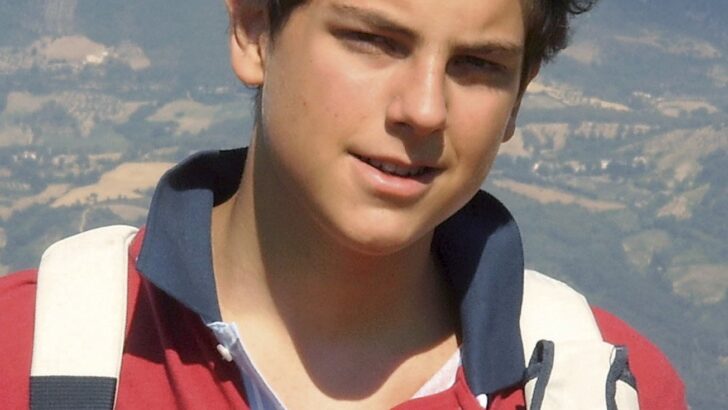
 Blessed Carlo Acutis, who will be canonized April 27, 2025, is pictured in an undated photo. The planned canonization of Blessed Carlo in Rome, was put on hold until the election of a new pope. (OSV News photo/courtesy Sainthood Cause of Carlo Acutis)
 An Italian boy dies of leukaemia at the age of 15. Now Carlo Acutis is canonised because he was particularly pious and socially committed. In addition to enthusiasm, the honour also triggers criticism.

The boy in the red polo shirt smiles somewhat shyly into the camera, carrying a rucksack over his shoulders. Carlo Acutis, who died of leukaemia in 2006 at the age of 15, was a completely normal teenager, “one of us”, is the message of the countless pictures circulating of the Italian. He will soon be elevated by the Catholic Church to a role model for believers worldwide. Because he was not only pious and charitable, but also used his talent for the faith.
The canonisation of the “internet apostle” and first millennial in the long line of Catholic saints was initially planned for the Sunday after Easter (27 April). But then Pope Francis died a few days earlier; the big celebration was cancelled and everything else was left to the new pope. Now Leo XIV has decided: The first saint of “Generation Y” will be raised “to the honour of the altars” on 7 September.
Hype with unusual traits
The hype surrounding Carlo Acutis has been taking on unusual characteristics for some time – at least since his beatification, which took place in Assisi in October 2020. The glass coffin in the church of Santa Maria Maggiore there, in which the boy can be seen wearing a tracksuit jacket, jeans and trainers, was visited by a million people last year. The glass coffin can also be viewed in a live stream. A fragment of his bed, a piece of a jumper and the sheet with which he was covered after his death are on display in a church in Rome.
His heart, which is kept in a precious reliquary, went on a tour of Europe in 2024. In German-speaking countries, too, many young people came to churches to have their picture taken with the heart of the “Cyber Apostle”. Biographies, films and documentaries tell the story of the son of wealthy parents.
Two miracles recognised
Most of what is known about him comes from his mother Antonia Salzano, who, together with high-ranking clergymen, worked intensively to ensure that her son was honoured by the Church. To this end, the Vatican recognised his virtuous lifestyle and two miracles: medically inexplicable healings of two people which, according to the church’s conviction, took place through the intercession of the deceased with God.
School, leisure, sport: Carlo, the boy who is said to have loved karate, tennis and skiing. And even as a small child, he wanted to attend mass every day to be united with Jesus. The Eucharist was his “motorway to God”, according to a quote from the boy. He used his pocket money to buy sleeping bags and food for people in need. He used his enthusiasm for the internet for his home parish in Milan. He also compiled a collection of 108 Eucharistic miracles, which can now be found on his own website. Critics see a problem here.
The “List of Eucharistic Miracles in the World” mainly lists “host miracles”, i.e. apparitions of consecrated hosts, which mainly appear from the 11th century onwards. This is a sensitive issue, as such miracles were sometimes preceded by a “host crime” – in which Jews were accused of being the alleged perpetrators.
Criticism from the anti-Semitism commissioner
Criticism of the Catholic Church has therefore come from the German government’s commissioner against anti-Semitism, Felix Klein: “I criticise the fact that the fact that some of the ‘Eucharistic miracles’ led to the murder of Jews does not seem to have played a role in the process on the way to canonisation,” Klein told the Catholic News Agency (KNA).
Some of the miracles listed by Acutis had centred on blood ostia, which in the historical context had been accompanied by accusations of ritual murder against Jews – “and associated with this, also deadly attacks on them”. According to Klein, it is “urgently necessary” that this aspect is not only discussed and analysed by the Catholic Church on demand.
Mother present at the canonisation
In the Vatican, the criticism of the plans for canonisation does not seem to have changed anything. When it takes place on 7 September, the mother will be present when her child is raised to the honour of the altars. This is an extremely rare occurrence, as such procedures usually take decades. The last time this happened was almost exactly 75 years ago: on 24 June 1950, the martyr Maria Goretti (1890-1902) was canonised – in the presence of her 85-year-old mother Assunta Goretti.