

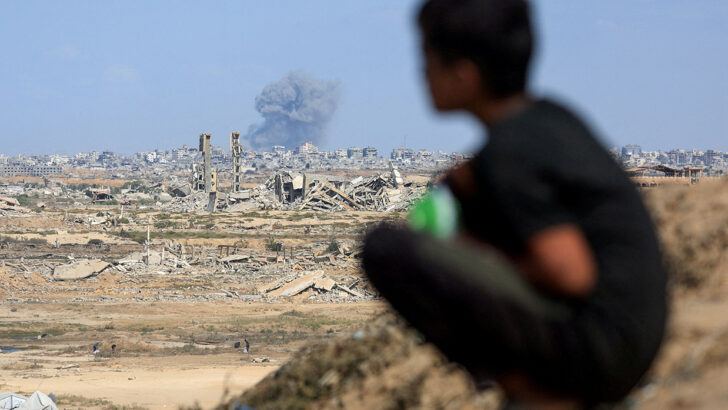
 Smoke rises following explosions amid the Israeli military offensive in Gaza City as seen from the central Gaza Strip on October 6, 2025. Photo: OSV News/Dawoud Abu Alkas, Reuters.
 Two years ago, we watched with horror what had happened to innocent Israeli citizens as they enjoyed a music festival. Since then, we have witnessed the daily news from Gaza and shook our heads in disbelief: bombed hospitals, broken homes, frightened children. Now, at last, there are signs of hope — the announcement of a ceasefire and a peace deal including the release of hostages. Yet such developments cannot erase the horror of recent months. Much of the international community, including respected human-rights experts, has concluded that what has taken place in Gaza amounts to genocide. A ceasefire or treaty may halt the bombs, but it cannot undo the graves already filled.
For many Irish Catholics the question comes quickly: what can we do? It is tempting to think the answer is ‘nothing.’
But faith never allows us the luxury of despair. We are, after all, living through the Jubilee Year of Hope — a reminder that Christian hope is not naive optimism but a stubborn conviction that light can still break through the darkest night. To be Christian is to believe that even the smallest act of love matters. The Gospel tells us that silence in the face of suffering is not an option.
A peace deal does not end suffering overnight. It marks the beginning of a long road to healing and rebuilding — a road that will need our prayer, vigilance, and compassion long after the headlines fade.
Nationally
Nationally, Ireland has not been afraid to make difficult choices. Recent debate about withdrawing from the Eurovision Song Contest if Israel competes may seem trivial, yet cultural boycotts can matter.
Forty years ago, Dunnes Stores workers in Dublin refused to handle fruit from apartheid South Africa. Ten young employees and a single tinned pineapple sparked an international story; years later Nelson Mandela thanked them. Ordinary people, acting on conscience, can move the world.
As the peace process begins, Ireland’s trade and investment links take on renewed importance. But peace built on silence or selective memory is no peace at all. Goods from Israeli settlements in the occupied territories make up only a small fraction of overall trade, and the Government has moved to restrict those through proposed legislation. Yet this is a moment for deeper reflection: how can our economic choices help to sustain a peace grounded in justice and accountability, not just convenience?
It is easy to point to governments or corporations, but what can an ordinary Catholic do? More than we think:
Pray with an intention for the Holy Land.
Write to your TDs and MEPs for a lasting ceasefire, recronstruction and humanitarian access.
Support targeted boycotts/divestments.
Support Trócaire, Caritas, or Médecins Sans Frontières.
Listen to Palestinian Christian voices.
True peace is never simply the absence of war. The prophets teach that peace and justice belong together, or not at all. For Christians, remembering the victims and insisting on truth is not vengeful — it is faithful.
Ireland has a history of standing with the oppressed. The ordinary Irish person may feel powerless, but our story says otherwise. Every prayer, every euro, every letter, every ethical choice, every refusal to stay silent is a sign of hope.
The first steps toward peace now being taken are fragile. What happens next will depend on whether people of conscience, here and everywhere, keep that hope alive — not only in words, but in the daily choices that build justice.
The power of one!
When Communism collapsed in the Soviet Union, Russian leader Boris Yeltsin was asked what inspired him to lead the change. He named Lech Walesa, the Polish shipyard worker who sparked a revolution. When Walesa was asked who had inspired him, he said it was the teachings of Martin Luther King Jr. And when Dr King was asked where he found his inspiration, he pointed to Rosa Parks — a quiet but determined Black woman in Alabama who, in 1955, refused to give up her bus seat to a white passenger.
Her simple act of courage ignited the American civil rights movement.
Is it too much of a stretch to say that Rosa Parks set in motion the ripples that helped bring down Communism?
Communion
During his homily at a First Communion Mass, the priest was explaining the Eucharist. “The Bible calls it a ‘joyful feast,’” he said. “Now, ‘joyful’ means happy, and a feast is a meal — so a joyful feast is a happy meal. And what do we need for a happy meal?”
Little Johnny shot up his hand: “A hamburger, fries, and a regular soft drink!”